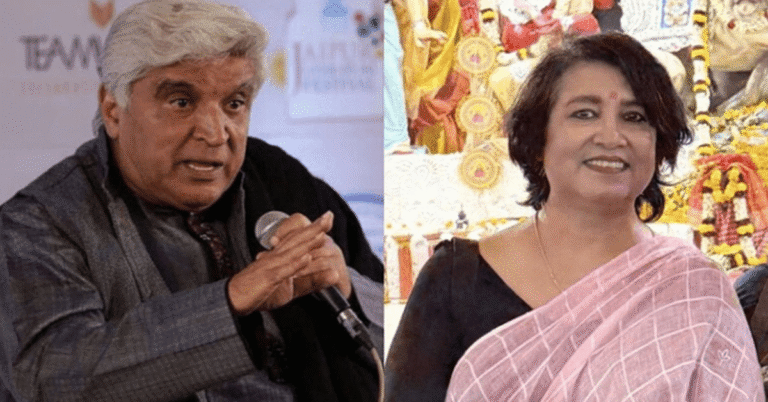

Exiled Bangladeshi author Taslima Nasreen has stirred a debate with her strong statement on Bengali identity and culture. She argued that Hindu culture is the foundation of Bengali culture, including that of Bengali Muslims. Her comments, made during Durga Puja celebrations, drew a critical yet thoughtful response from celebrated poet and lyricist Javed Akhtar, who highlighted the importance of India’s Ganga Jamni Awadh culture.
Taslima Nasreen’s Bold Claim During Durga Puja
Nasreen made the remarks in an online post on the morning of Ashtami, one of the most significant days of Durga Puja, the biggest festival for Bengali Hindus. Sharing images of Durga pandals and cultural events, she said that Bengalis, regardless of religion, share a common cultural foundation that links them to India.
Table of Contents
Her post read:
“There is nothing to conceal: Hindu culture is the foundation of Bengali culture. We Bengalis—whatever religion or philosophy we may have embraced over history—belong, in our national identity, to India. The forefathers and foremothers of Hindus, Buddhists, Christians, Muslims, and even atheists of India were all, or nearly all, Indian Hindus.”
This statement not only emphasized Hindu roots in Bengali culture but also linked Bengali identity directly with India’s cultural heritage.
“Bengali Muslims’ Culture Not Arabic”
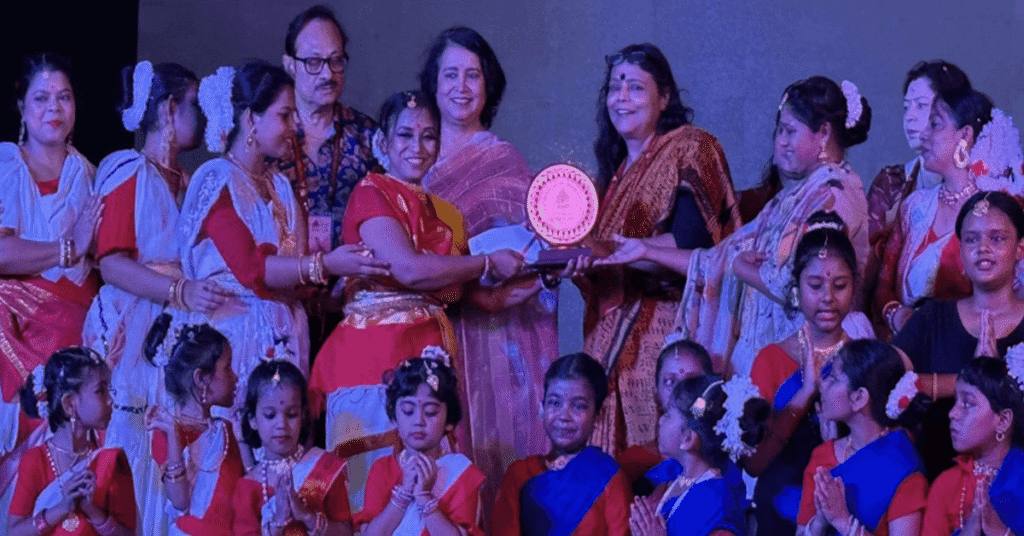
Nasreen, often seen as outspoken and critical of religious orthodoxy, further argued that Bengali Muslims’ culture is not Arabic but firmly rooted in local traditions.
She explained:
“Even if a Bengali is Muslim, his culture is not the culture of Arabia. His culture is Bengali culture, and that culture is rooted in Hindu tradition. The beating of drums, the music, the dance—these are the primal expressions of Bengali culture. This is what it means to be Bengali. To deny it is to deny oneself.”
According to Nasreen, music, art, literature, and festivals are the essence of Bengali identity, and these elements cannot be separated from Hindu cultural traditions.
Javed Akhtar’s Response: Respect Ganga Jamni Culture
Noted poet and lyricist Javed Akhtar responded with a more balanced take. While acknowledging his respect for Bengali culture, he stressed the need to value the Ganga Jamni Tehzeeb (Awadh culture), a unique blend of Hindu and Muslim traditions that has shaped northern India for centuries.
He said:
“We the people of traditional Awadh have great respect for Bengali culture, language, and literature. But if someone is unable to appreciate and respect the great Ganga Jamni Awadh culture and its refinement, its sophistication, then it’s completely his loss. This culture has nothing to do with Arab.”
Influence of Persian and Central Asian Cultures
Akhtar further explained that Indian culture is not limited to Hindu traditions alone. It has absorbed Persian, Central Asian, and Western influences, but always on its own terms.
READ ALSO- Delhi Man, 35, Weds 65-Year-Old US Woman; Indian Parents Stir Drama — ‘Dhoom Tana Na’ Goes OTT
“Persian and Central Asian cultures and languages have seeped into our culture and language, like western culture, but on our terms and conditions. By the way, many Bengali surnames are in Persian,” he pointed out.
His remarks highlight the plurality of Indian culture, where influences from different regions and religions merge without erasing local traditions.
Debate Over Identity and Belonging
Nasreen’s statement that all Bengalis belong to India has sparked debate online. Supporters say her words emphasize the deep connection between Hinduism and Bengali cultural practices such as Durga Puja, Rabindra Sangeet, Baul songs, and folk dances. Critics, however, caution against ignoring the contributions of Islamic traditions and the shared cultural journey of Hindus and Muslims in Bengal.

Javed Akhtar’s response adds an important perspective by reminding people of India’s long history of syncretic traditions, where Hindu and Muslim cultures coexisted, influencing each other in food, music, language, and lifestyle.
The Larger Context
This exchange comes at a time when identity politics and cultural roots are often debated in South Asia. Nasreen, who has lived in exile for decades due to threats from extremists in Bangladesh, has consistently defended freedom of expression and criticized religious orthodoxy.
Her latest remarks during Durga Puja add another layer to her controversial yet thought-provoking views. Meanwhile, Akhtar’s reminder about Ganga Jamni Awadh culture underscores India’s diversity and the richness of its shared cultural fabric.
The debate between Taslima Nasreen and Javed Akhtar is not just about Bengali culture but about what it means to be Indian. Nasreen emphasizes that Hindu traditions form the backbone of Bengali identity, while Akhtar highlights the importance of India’s composite culture, shaped by multiple influences over centuries.
Together, their views reflect the complex, layered identity of India, where religion, culture, and history intersect in unique ways. The conversation continues to spark discussion, showing how cultural heritage remains central to questions of belonging and identity in the subcontinent.


 By
By


 anm"ala dig till binance says: