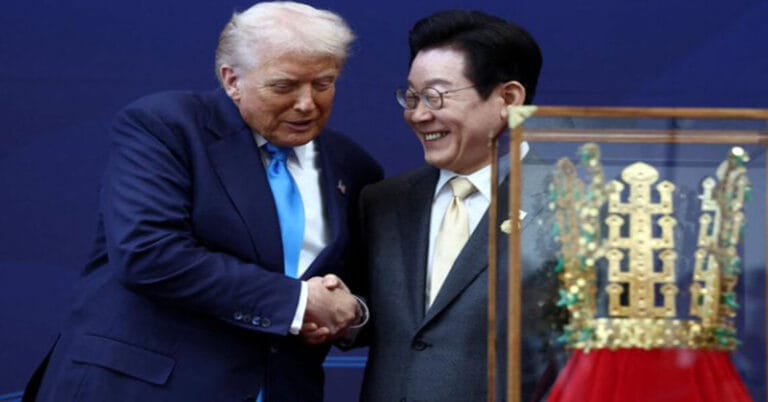

U.S. President Trump left for Washington on Thursday (October 30, 2025) after holding an important meeting with Chinese President Xi Jinping in South Korea. The face-to-face discussion marked the final stop of Trump’s five-day trip across Asia, which aimed to stabilize relations between the world’s two largest economies after months of rising trade tensions.
A Crucial Meeting Amid Trade Strain
Table of Contents
The highly anticipated meeting between Trump and Xi took place in the South Korean port city of Busan, located about 76 kilometres from Gyeongju, where the Asia-Pacific Economic Cooperation (APEC) summit was being held. The talks lasted for about 1 hour and 40 minutes. Although the two leaders covered a wide range of topics, there was no official statement from either side immediately after the meeting ended.
According to sources familiar with the agenda, the discussions focused on key economic issues such as tariffs, computer chips, rare earth minerals, and ongoing trade restrictions. These topics have been central to the strained relationship between Washington and Beijing in recent months.
Before the meeting, President Trump expressed optimism about finding common ground with China. “I expect to be able to reach a deal with President Xi,” Trump told reporters earlier in the week, signaling his desire to ease tensions that have affected global trade and markets.
No Immediate Statement from White House
After the meeting concluded, President Trump boarded Air Force One to return to Washington without making any public comments. The White House also did not release any statements or details about the outcome of the discussion. This silence has fueled speculation about whether the talks produced any tangible progress.
Trump’s five-day tour included visits to Japan, South Korea, and China’s neighboring regions, focusing mainly on strengthening trade ties and addressing regional security issues. His meeting with Xi was widely seen as the highlight of the trip, given the growing economic rivalry between the two nations.
Tariffs and Trade Take Center Stage

Since returning to the White House for a second term, President Trump has adopted a tough stance on trade with China, reintroducing tariffs on several Chinese goods. In response, China imposed restrictions on the export of rare earth minerals—key materials used in electronics, defense, and clean energy industries.
This back-and-forth has created uncertainty in global markets and added pressure on both countries to find a middle ground. Analysts believe the Busan meeting was an attempt to prevent the situation from worsening and to protect the fragile global economy.
READ ALSO- Video of Driverless Car in Bengaluru Goes Viral as Seer Enjoys a Joyride“There is a growing recognition that neither side wants to trigger an economic crisis that could hurt their own industries and people,” a senior U.S. official was quoted as saying.
Trump Hints at Reducing Tariffs
During his flight to South Korea earlier in the week, President Trump hinted that he might reduce some tariffs on Chinese goods, particularly those related to the production of fentanyl, a synthetic opioid that has caused a major drug crisis in the United States.
“I expect to be lowering that because I believe they’re going to help us with the fentanyl situation,” Trump told reporters aboard Air Force One. He added, “The relationship with China is very good.”
While Trump’s comments suggested a more cooperative tone, experts caution that progress on major trade issues will require continued dialogue and concrete action from both sides.
The Trump-Xi meeting in South Korea may not have produced immediate breakthroughs, but it signaled a willingness from both countries to re-engage diplomatically after months of escalating rhetoric.
Observers believe that follow-up meetings and technical discussions could take place in the coming months to explore potential agreements on tariffs, technology transfers, and raw materials.
For now, the world will be watching closely to see whether this latest round of talks marks the beginning of a more stable phase in U.S.-China relations—or just another pause in an ongoing economic rivalry that continues to shape global politics.


 By
By