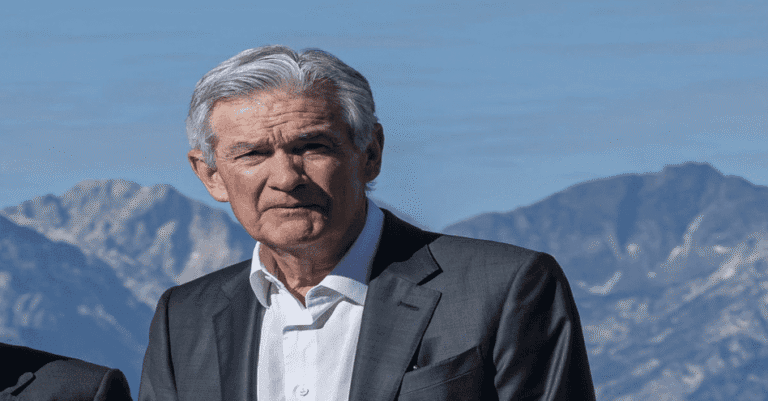

JACKSON HOLE, Wyoming, Aug 22 (Reuters) – Federal Reserve Chair Jerome Powell on Friday hinted at a possible interest rate cut at the central bank’s upcoming meeting, citing rising risks to the labor market while cautioning that inflation pressures remain and no final decision has been made.
Though less direct than his remarks at last year’s Jackson Hole conference, Powell’s comments prompted investors to raise expectations of a quarter-point rate cut at the Fed’s September 16–17 meeting.
Several Wall Street analysts told clients they were revising forecasts, abandoning earlier expectations that the Federal Reserve would wait until December to cut rates. Many now anticipate reductions totaling half a percentage point by year’s end, from the current 4.25%–4.50% range.
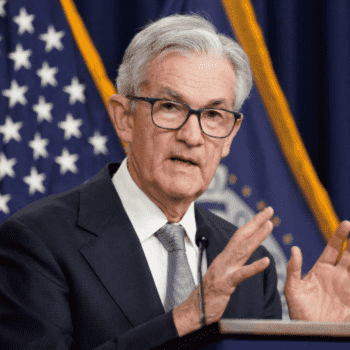
Tariffs Pose Inflation Uncertainty, Powell Warns
“The stability of the unemployment rate and other labor market measures allows us to proceed carefully as we consider changes to our policy stance,” Powell said, addressing international economists and policymakers at the Fed’s annual conference in Wyoming. “Nonetheless, with policy in restrictive territory, the baseline outlook and the shifting balance of risks may warrant adjusting our stance.”
Powell’s remarks placed significant focus on upcoming economic data, with the monthly employment report due September 5 and inflation figures expected the following week. The latest labor market data showed payroll growth slowing sharply, averaging just 35,000 jobs per month between May and July, though the unemployment rate remained relatively low at 4.2%.
“While the labor market appears to be in balance, it is a curious kind of balance that results from a marked slowing in both the supply of and demand for workers,” Powell said. “This unusual situation suggests that downside risks to employment are rising — and if those risks materialize, they can do so quickly.”
He added that while tariffs are expected to push prices higher in the near term, their impact on inflation is likely to fade. “It is also possible, however, that the upward pressure on prices from tariffs could spur a more lasting inflation dynamic, and that is a risk to be assessed and managed,” Powell cautioned.
U.S. stocks climbed following Powell’s remarks, while traders raised the probability of a quarter-point Fed rate cut next month to about 85%, up from 75% earlier in the day. Market expectations also point to a second reduction in December. In response, U.S. Treasury yields fell and the dollar weakened.
“Chair Powell came in more dovish than expected,” said Thomas Hayes, chairman of Great Hill Capital LLC. “He has set the table to move in September.”
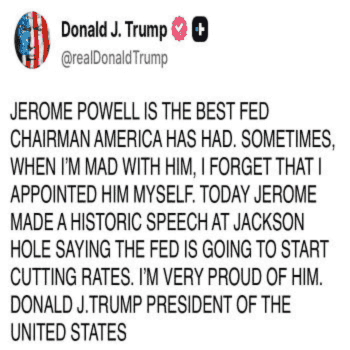
TRUMP PRESSURE CAMPAIGN
Powell’s comments quickly drew criticism from former President Donald Trump, who has repeatedly argued there is no inflation risk and that the Fed should cut rates without delay.
“We call him ‘too late’ for a reason. He should have cut them a year ago. He’s too late,” Trump said. In reality, the Fed did lower rates by a full percentage point in the months following last year’s Jackson Hole conference.
Trump has intensified pressure on the Federal Reserve, renewing calls for Powell to resign and extending his campaign this week to demand that Fed Governor Lisa Cook also step down.
As Powell delivered his remarks, Trump wrote on his Truth Social platform that he would fire Cook if she refused to resign. By law, however, Fed Board members can only be removed “for cause,” such as misconduct. The Justice Department, acting on a referral from the Trump administration, has opened an investigation into alleged misstatements about Cook’s mortgages on two properties. Cook, who is attending the Jackson Hole conference, has said she will not be bullied into leaving her post.
Even as political tensions swirled, a difficult policy debate was also evident inside the Fed. Some officials signaled reluctance to endorse a near-term rate cut. Kansas City Fed President Jeffrey Schmid, who hosted the event, and Cleveland Fed President Beth Hammack both said in television interviews against the backdrop of the Grand Teton range that they remain cautious about easing policy while inflation is still above target and not yet on track to return sustainably lower.
Other policymakers at Jackson Hole, including Governor Christopher Waller, argued that the impact of tariffs would likely be modest and short-lived, making rate cuts appropriate to shield a weakening labor market. Waller, who is seen as a potential successor to Powell, has emerged as one of the more prominent voices calling for immediate easing.
Powell’s remarks leaned closer to Waller’s stance, echoing recent comments from officials such as San Francisco Fed President Mary Daly, who has urged a “recalibration” of interest rates.
BREAKING: In a stunning moment, Jerome Powell just doubled down on blaming Donald Trump’s tariffs for slowed economic growth in the U.S. Donald Trump is not going to like this.pic.twitter.com/G4saHg3nEE
— Democratic Wins Media (@DemocraticWins) August 22, 2025
The Fed chair received a standing ovation as he began his speech — a symbolic moment at the close of eight years marked by both achievement and relentless criticism from Trump. Though Trump nominated Powell during his first term, he quickly soured on him for refusing to keep policy as loose as the White House wanted. The Trump administration is now seeking Powell’s replacement while pressuring him and other Fed Board members to resign in hopes of reshaping the seven-member body.
The Fed chair cannot be removed over disagreements about rate policy. Powell, reappointed to a second term by President Joe Biden, has said he intends to serve out his mandate until it expires next May.
Fed Rate Cut Probabilities
Confidence in a September rate cut had been slipping in the days leading up to Powell’s Jackson Hole address. But his dovish tone revived market bets that reductions are likely soon.
Alongside his economic update, Powell unveiled a new strategic framework underscoring that the Fed’s maximum employment mandate depends on maintaining price stability.
The Fed has kept benchmark rates unchanged at every meeting this year as Powell and other officials waited to gauge the impact of Trump administration policies on inflation, which remains above the 2% target.
“He had been saying ‘wait and see.’ He now seems more in the camp that ‘we have waited and we have seen, and we haven’t seen that much,’” said former Fed Governor Randall Kroszner. “It looks now likely that the impact of tariffs will be more of a one-off… I do think the labor market is slowing. Policy has been quite restrictive for quite some time.”
Reporting by Howard Schneider and Ann Saphir; Additional reporting by Ragini Mathur and Andrea Shalal; Editing by Paul Simao and Andrea Ricci.


 By
By