
No More 2-Year B.Ed! New 1-Year Course – The Indian government has announced a major reform in teacher education: the 1-year Bachelor of Education (B.Ed) program will return starting from the 2026–27 academic session. This landmark move comes after more than a decade of the mandatory 2-year B.Ed framework, introduced in 2014 by the National Council for Teacher Education (NCTE).
Aligned with the National Education Policy (NEP) 2020, the decision aims to make teacher training more efficient, flexible, and globally competitive.
Background: Evolution of the B.Ed Program
The B.Ed course has undergone several structural changes over the years:
- Before 2014: It was a 1-year program.
- 2014 onwards: NCTE made the course 2 years long, aiming to improve training quality.
- Outcome: Longer duration led to lower enrollments, ineffective internships, and delayed teacher induction.
These drawbacks compelled the government to reintroduce the 1-year B.Ed program with updated eligibility norms.
Why the Duration of B.Ed Changed No More 2-Year B.Ed
Table of Contents
The rollback to 1 year was driven by multiple concerns:
- Low Enrollment: Students avoided teaching careers due to the extra study year.
- Ineffective Curriculum: Institutions struggled to deliver meaningful internships.
- Delayed Teacher Induction: The 2-year gap slowed down workforce entry into schools.
- Mismatch with NEP 2020: The rigid structure didn’t align with NEP’s flexible and dynamic vision for teacher training.
Eligibility Criteria for the 1-Year B.Ed Program

From 2026–27, the 1-year B.Ed will not be open to everyone. The government has set strict eligibility standards to ensure quality.
| Academic Qualification | Eligibility for 1-Year B.Ed |
|---|---|
| 4-Year Integrated UG Degree (like ITEP) | Eligible |
| Postgraduate Degree (MA, MSc, MCom, etc.) | Eligible |
| 3-Year UG Degree (BA, BSc, BCom) | Not Eligible – must pursue 2-Year B.Ed |
Differences Between 1-Year and 2-Year B.Ed Programs
| Feature | 1-Year B.Ed | 2-Year B.Ed |
|---|---|---|
| Duration | 1 Year (2 Semesters) | 2 Years (4 Semesters) |
| Internship | Condensed but intensive | Spread across 2 years |
| Admission Requirement | 4-Year UG or PG degree | Minimum 3-Year UG |
| Cost & Time | Lower | Higher |
What Happens to the 2-Year B.Ed?
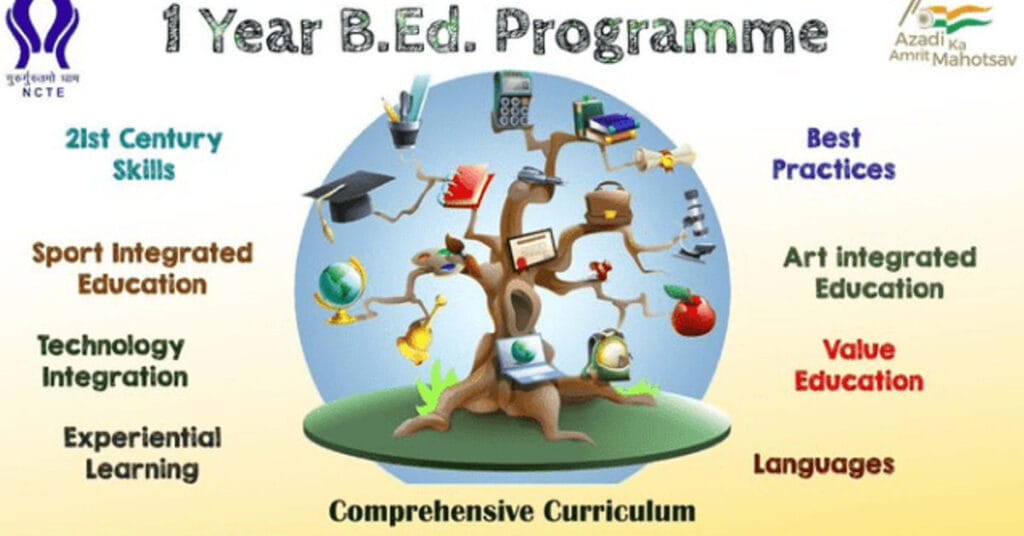
The 2-year program will not disappear immediately. It will remain available for students who only have a 3-year undergraduate degree. Over time, as Integrated Teacher Education Programs (ITEP) and PG-qualified students become more common, the 2-year version will gradually phase out.
Introduction of the 1-Year M.Ed Program
Alongside the B.Ed reforms, the Master of Education (M.Ed) will also be revamped:
- 1-Year M.Ed: Available for candidates with a 4-year integrated UG degree (like ITEP) or a B.Ed.
- 2-Year M.Ed: Still available for others, including working teachers.
Rise of Integrated Teacher Education Program (ITEP)
The ITEP is a 4-year dual-degree program combining B.A./B.Sc. and B.Ed. It prepares teachers from the ground up and aligns with NEP 2020’s holistic education goals.
Specializations Starting in 2025–26
- Yoga Education
- Art Education
- Sanskrit
- Physical Education
These additions will diversify teacher training and enrich Indian classrooms.
Benefits of the New 1-Year B.Ed Format
- Saves Time: Reduces one year from the academic journey.
- Cuts Costs: Lower tuition fees and living expenses.
- Attracts Quality Students: Encourages postgraduates and integrated degree holders.
- Supports NEP Goals: Promotes flexibility, innovation, and global standards.
Concerns and Criticism
While many welcome the reform, some experts have flagged challenges:
- Training depth might suffer with a shorter program.
- Institutions may face difficulty adapting the curriculum quickly.
- Transition for current 2-year students could create confusion.
The government has assured proper rollout guidelines and support for smooth implementation.
Impact on Students and Institutions
- For Students: A faster, more affordable entry into teaching careers, especially for PG holders.
- For Institutions: Curriculum redesign and faculty adjustments, but likely higher enrollment due to reduced duration and costs.
Revised Fee Structure for B.Ed Programs

In June 2025, the government revised the B.Ed fee structure. The updated fees range from ₹32,000 to ₹45,000 annually, making teacher education more affordable and encouraging more students to join the profession.
ALSO READ- GST on Petrol, Diesel & Alcohol: Will Fuel and Liquor Prices Drop from Today? Key Details
Key Implementation Timeline (2023–2026)
| Year | Key Changes |
|---|---|
| 2023–24 | ITEP pilot programs launched |
| 2024–25 | Curriculum updates and approvals |
| 2025–26 | Specializations introduced |
| 2026–27 | 1-Year B.Ed and M.Ed fully implemented |
FAQs on the New B.Ed Structure
Q1. Is the 1-year B.Ed for everyone?
No, only for postgraduates or 4-year UG degree holders.
Q2. Can BA graduates apply for the 1-year B.Ed?
No, they must pursue the 2-year version.
Q3. When will the change take effect?
From the 2026–27 academic session.
Q4. Is the 2-year B.Ed discontinued?
Not yet. It remains for students without PG or 4-year UG qualifications.
Q5. Will private colleges follow this rule?
Yes, all NCTE-affiliated institutions must adopt the changes.
The reintroduction of the 1-year B.Ed program marks a significant shift in India’s teacher education landscape. By reducing duration and aligning with NEP 2020, the government hopes to attract more students to teaching while maintaining quality through stricter eligibility norms.
This change is not just about shorter courses—it represents a step toward global alignment, affordability, and efficiency in India’s education sector.


 By
By


 sign up binance says: