
Thiruvananthapuram:
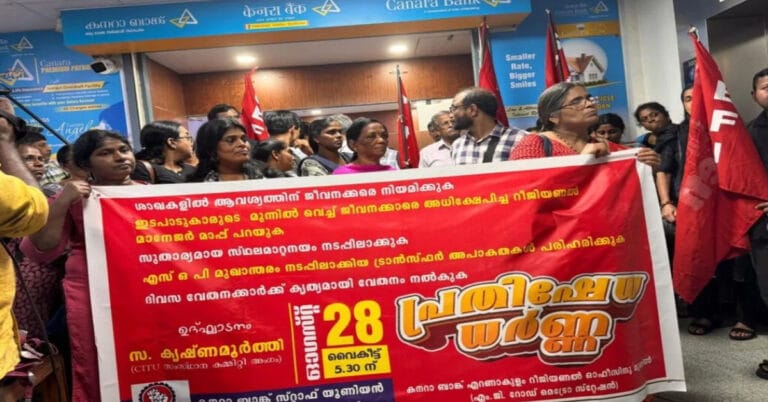
A unique protest unfolded in Kochi, Kerala, on Thursday when employees of a Canara Bank branch staged what they called a “beef party” outside their office. The demonstration came in response to an alleged order by the branch’s Deputy Regional Manager, Ashwini Kumar, banning beef from being served at the office canteen.
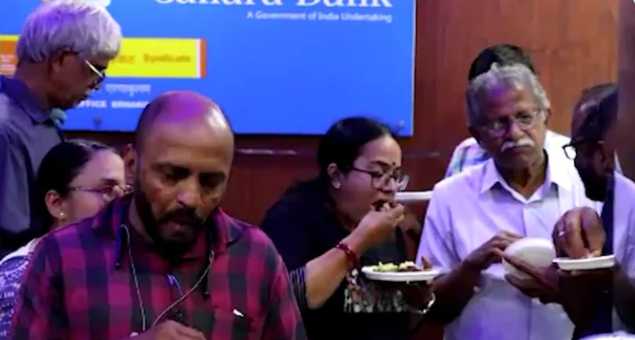
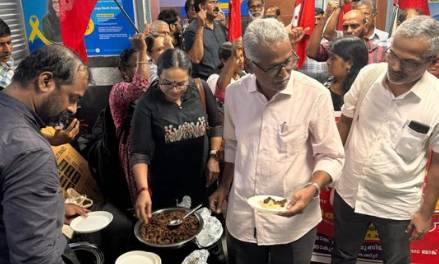
The protest was not spontaneous—it was carefully planned by the Bank Employees Federation of India (BEFI). Initially, the demonstration was intended to highlight allegations of workplace harassment by the same officer. However, when reports of the beef ban surfaced, the focus of the protest shifted sharply. Employees decided to resist the directive by serving beef and Kerala’s beloved parotta outside the branch premises, turning it into a cultural and political statement.
The Incident that Triggered the Protest
According to reports, Ashwini Kumar, recently transferred from Bihar to Kerala, took charge of the branch only a few weeks ago. Since assuming office, he has reportedly been at the centre of at least two controversies. The first was linked to alleged harassment of employees, and the second, which has now snowballed into a political issue, was his reported ban on beef dishes in the office canteen.
A Canara Bank branch in Kerala’s Kochi city organised a beef protest by eating meat in public, after the newly appointed regional manager allegedly imposed a ban in the canteen.
— The Siasat Daily (@TheSiasatDaily) August 30, 2025
Read more: https://t.co/JA0c5pjcuz pic.twitter.com/TiyJC47o2u
For Kerala, where beef is one of the most widely consumed meats across communities, such a restriction struck a particularly sensitive chord. Protestors said the move violated their personal freedom of choice, which is enshrined in the Indian Constitution.
Employees Push Back
By staging a beef party outside their own office, the protesting employees wanted to send a clear message: food is a personal matter and cannot be dictated by any authority figure. Dozens of employees gathered outside the branch building and shared plates of beef curry and parotta, a combination deeply rooted in Kerala’s culinary tradition.
A BEFI leader who addressed the protestors emphasized that the issue went beyond food—it was about safeguarding personal liberties. “Food is a personal choice, and that right is protected by the Constitution. No officer, however senior, has the authority to infringe upon that freedom,” the leader said.
Political Reaction
The controversy quickly drew the attention of political leaders across Kerala. KT Jaleel, an independent lawmaker supported by the ruling Left, condemned the alleged beef ban, calling it an attempt to impose cultural restrictions alien to Kerala’s ethos.
READ ALSO- Chennai IT Union Protests Mass Layoffs at TCS
In a strong statement on Facebook, Jaleel criticized what he described as attempts by “Sanghis” (a colloquial reference to members of the Rashtriya Swayamsevak Sangh, the ideological parent of the BJP) to enforce cultural conformity in Kerala. “It is not up to superior officers to decide what people wear, eat, or think,” he wrote. “No scandal of Sanghis will happen in Kerala. The soil here is red, and comrades will not allow anyone to raise the saffron flag and disturb the people.”
Jaleel’s words reflected the deep political undertones of the protest. For Kerala, where Left politics has historically played a strong role in shaping social movements, the beef issue once again became a symbol of resistance against what many see as attempts to homogenize India’s diverse food practices.
Beef and Kerala’s Culture
To understand the sensitivity surrounding the issue, one must look at Kerala’s cultural and culinary landscape. Unlike in many other parts of India, beef in Kerala includes both cow and buffalo meat, and its consumption cuts across caste and religious lines. Hindus, Muslims, and Christians alike consume beef, and it remains one of the most popular meats in the state.
Sales data has consistently shown beef to be Kerala’s most-consumed meat. For many families, dishes like beef curry, beef fry, or beef ularthiyathu with parotta are everyday meals, not cultural statements. Thus, any attempt to restrict beef consumption is perceived as an infringement not only on dietary choice but also on cultural identity.
The History of Beef Bans in Kerala
This is not the first time Kerala has resisted attempts at imposing beef bans. In 2017, when the central government issued a notification banning the sale of cattle for slaughter, Kerala erupted in protests. Beef festivals were organized at college campuses, and political parties across the spectrum rallied against the order. Eventually, widespread opposition forced the government to reconsider its stance.
The current controversy, though localized to a bank branch, resonates with that larger history. The Canara Bank employees’ protest is being seen not only as a workplace issue but also as part of Kerala’s broader fight to protect its cultural freedoms.
Silence from the Bank’s Leadership
As the controversy gathered attention, all eyes turned to Canara Bank’s central leadership. However, the management has so far maintained silence, neither confirming nor denying the allegations of a beef ban. For the protesting employees, this silence has been frustrating, as they hope for a clear stance from the institution on whether an individual manager has the authority to enforce such directives.
The beef party protest at Canara Bank’s Kochi branch has once again brought into sharp focus Kerala’s resistance to cultural impositions. What began as an office-level grievance has now grown into a politically charged issue, with leaders, unions, and citizens weighing in.
For many, the protest is not simply about what employees can or cannot eat in their canteen—it is about the larger principle of personal freedom. In Kerala, where beef is not merely food but a cultural mainstay, the controversy has struck a deep chord, reminding the rest of the country that attempts to dictate personal choices will always be met with spirited resistance.


 By
By