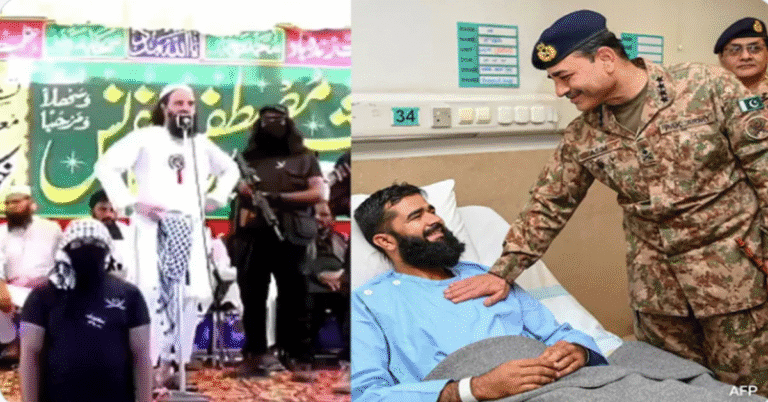

Jaish Member link wuth asim munir terror – A fresh controversy has erupted after a video surfaced online showing Masood Ilyas Kashmiri, a top commander of the terrorist group Jaish-e-Mohammad (JeM), making explosive claims about Pakistan’s military establishment. Speaking at the 38th annual Mission Mustafa conference, Kashmiri alleged that the Pakistan Army, under the leadership of Chief Asim Munir, actively supported terrorism by sending generals to the funerals of terrorists killed in India’s Operation Sindoor.
Direct Allegations Against Pakistan Army Chief
Table of Contents
For decades, Pakistan has consistently denied any involvement in sponsoring terrorist activities or harboring militant groups. However, Kashmiri’s open statement directly contradicted these official denials. He claimed that the Pakistan Army had dispatched senior military officers to attend funerals of JeM operatives eliminated in Indian counter-terrorism operations. This allegation sheds new light on Islamabad’s covert role in supporting extremist networks.
At the conference, Kashmiri did not hesitate to highlight the military’s involvement in providing “state honours” to slain terrorists. His revelation marks one of the rare instances where a senior JeM commander openly connected Pakistan’s top army leadership to terror activities, sparking outrage in New Delhi and across the international community.
India’s Evidence Against Pakistan
India has been systematically exposing Pakistan’s state-backed terrorism over the years. In May, during a press briefing in New Delhi, Indian Foreign Secretary Vikram Misri presented a photograph showing Abdur Rauf—a US-designated terrorist—leading funeral prayers at one such event. The photograph depicted the bodies of the slain terrorists draped in Pakistan’s national flag, attended by uniformed officers, highlighting the state’s complicity.
“As far as we are concerned, the individuals eliminated at these facilities were terrorists,” Mr. Misri remarked. “Giving terrorists state funerals may be a practice in Pakistan. It doesn’t make much sense to us.” His comments reinforced India’s consistent narrative that Pakistan uses state machinery to nurture and glorify terrorism.
Asim Munir’s Controversial Statements(Jaish Member Asim Munir’s Terror Links)
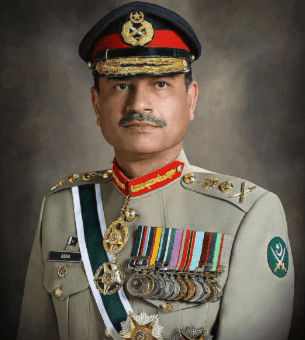
The controversy deepened when Asim Munir himself drew global attention through his aggressive rhetoric. In an address at Tampa, Florida this August, Munir warned that Pakistan, being a nuclear power, would not hesitate to drag others down if it faced existential threats in a conflict with India. His words—“If we think we are going down, we’ll take half the world down with us”—sparked condemnation in Washington.
Former Pentagon official Michael Rubin harshly criticized Munir, saying, “Asim Munir is Osama bin Laden in a suit.” Rubin highlighted that Munir’s stance reflects a dangerous ideological undercurrent that the global counter-terrorism community should not ignore. Such statements positioned Pakistan further as a rogue state in the eyes of global observers.
Contradictions in International Diplomacy
Despite these alarming developments, the United States continued to maintain diplomatic ties with Munir. In June, barely weeks after India launched Operation Sindoor, Munir was invited for a lunch with then-US President Donald Trump. Furthermore, US Central Command chief General Michael Kurilla called Pakistan a “phenomenal partner” in counter-terrorism efforts, adding to the growing contradictions in global diplomacy.
India’s Push for FATF Re-Listing of Pakistan
Under increasing pressure, India is preparing to send a comprehensive dossier to the Financial Action Task Force (FATF), demanding Pakistan’s inclusion back on the terror grey list. According to a report by The Hindu, India will highlight that Pakistan has failed to implement the mandatory anti-terror law, which was a condition for its removal from the grey list in 2022.
READ ALSO- Assam Top Officer Caught: Rs 2 Crore Cash, Gold Seized; Joined Service in 2019
A government official stated, “The FATF itself has enough reason to re-list Pakistan, and our dossier will reinforce the case.” The move aims to hold Pakistan accountable for its ongoing support of terror networks and its failure to meet international obligations.
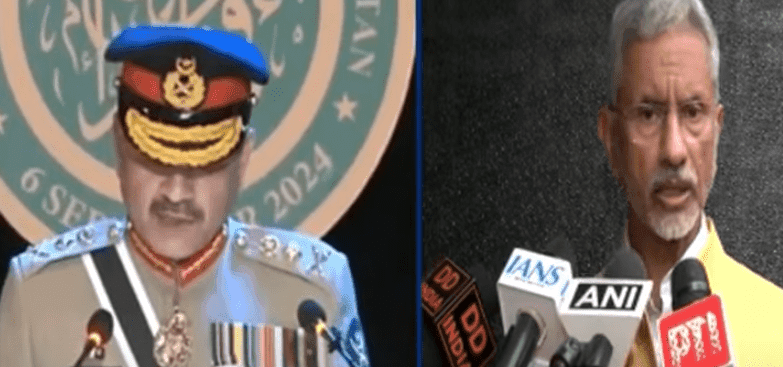
Masood Ilyas Kashmiri’s startling revelations have further strained Indo-Pak relations and amplified global scrutiny of Pakistan’s terror policies. With hard evidence and mounting international criticism, India continues to push for decisive global action against Pakistan’s state-sponsored terror machinery. The political and diplomatic fallout of this controversy is expected to unfold in the coming months, reshaping the regional security landscape.


 By
By

 b"asta binance h"anvisningskod says:
 Binance推荐代码 says: