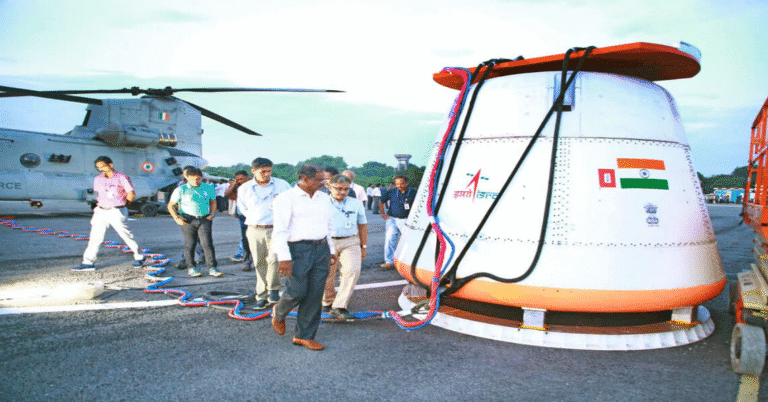

ISRO successfully conducts first Integrated Air Drop Test for Gaganyaan mission’s parachute-based deceleration system.
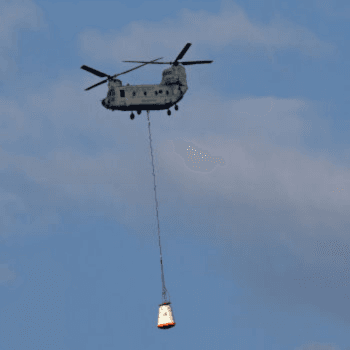
The Indian Space Research Organisation (ISRO) has completed its first Integrated Air Drop Test (IADT-01), showcasing the end-to-end demonstration of the parachute system designed to slow down the Gaganyaan crew module during re-entry.
The test marks a crucial milestone in validating the safety systems needed to ensure astronauts’ safe return to Earth. According to ISRO, the demonstration was carried out in close coordination with the Indian Air Force, DRDO, Indian Navy, and Indian Coast Guard.
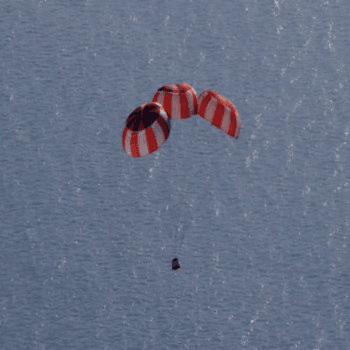
Sharing the achievement on X, the space agency wrote: “ISRO successfully conducts its first Integrated Air Drop Test (IADT-01), demonstrating the parachute-based deceleration system for Gaganyaan missions. This success is the result of a joint effort by ISRO, the Indian Air Force, DRDO, Indian Navy, and Indian Coast Guard.”
Gaganyaan test flight scheduled for December
ISRO Chairman V. Narayanan has confirmed that India’s first uncrewed Gaganyaan mission, G1, will take flight in December carrying the half-humanoid robot Vyommitra, according to News On Air.
Speaking at a press conference in New Delhi, Narayanan said the Gaganyaan programme is on track, with nearly 80% of tests—about 7,700 out of 10,000—already completed. He added that the remaining 2,300 tests are expected to be finished by March next year.
“Chandrayaan-3, Vikram’s gentle landing—etched forever in memory. The control centre screens still glow with pride. A game-changing moment for India. Congratulations #ISRO on ‘National Space Day’! 🚀🇮🇳 pic.twitter.com/Vq84Ak1EKR
— Dr. S Somanath (@SomanathSpeak) August 23, 2025
Earlier, Union Minister of State for Science and Technology Jitendra Singh announced that the development and ground testing of the Human Rated Launch Vehicle (HLVM3) for India’s first human spaceflight mission, Gaganyaan, has been successfully completed, according to news agency ANI.
“Precursor Missions: A Test Vehicle developed for validating CES and flight tested in TV-D1. Activities are in progress for TV-D2 and IADT-01. Flight Operations and Communication Network: Ground network configuration finalised. IDRSS-1 feeder stations and terrestrial links established. Crew Recovery Operations: Recovery assets finalised. Recovery Plan worked out. First Uncrewed Mission (G1): C32-G stage and CES motors realised. HS200 Motors and CES Fore end up to Crew Module Jettisoning Motor stacked. Crew Module and Service module structure realised. Crew Module Phase-1 checks completed,” he added.
ALSO READ – Syrian Man in Gujarat Dupes Donors: Gaza Funds Spent on Lavish Lifestyle
Future Missions
The upcoming Gaganyaan-1 mission will carry the half-humanoid robot Vyommitra into space as part of India’s first human-robot flight. Looking ahead, the country aims to launch its first crewed Gaganyaan mission in 2027, followed by Chandrayaan-4 in 2028, a dedicated Venus mission, and the establishment of the Bharat Antariksh Station by 2035, Jitendra Singh said.
He also announced India’s long-term goal of sending an Indian astronaut to the Moon by 2040.


 By
By

 odprite racun na binance says:
 Bonus Pendaftaran di Binance says:
 Binance注册奖金 says: