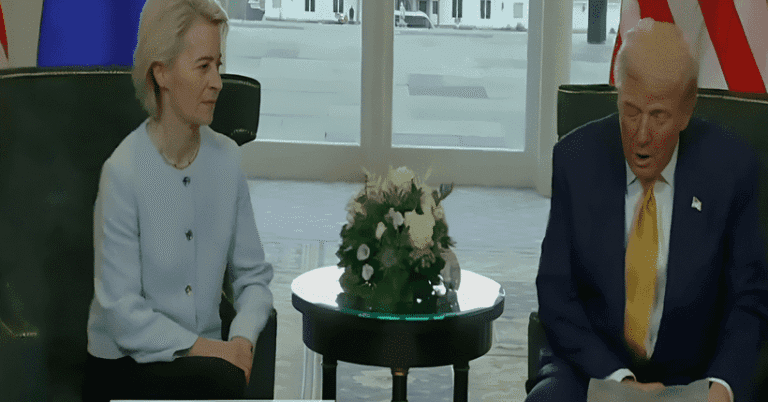

Now in its fourth year, the Russia-Ukraine war has prompted the United States and the European Union to prepare another round of economic measures designed to further tighten Moscow’s financial lifeline. At the heart of this push are secondary sanctions—penalties that not only target Russia itself but also countries and companies still doing business with it, particularly in the energy trade. This step signals a sharp escalation in the West’s economic offensive against Russia. However, it also risks widening global economic rifts, straining ties with major partners like India and China, and exposing contradictions within the EU’s own policies.
Unlike primary sanctions—which restrict a country’s own companies and citizens from dealing with blacklisted entities—secondary sanctions are designed to penalize third-party nations or businesses that continue to engage with them. The goal is to choke off Russia’s revenue streams even in regions where Western influence is limited. Such measures could involve freezing assets, blocking access to Western banking systems, banning insurance for oil tankers, or imposing tariffs on countries that maintain trade ties with Moscow.
Bloomberg reports that the EU’s proposed 19th round of sanctions could cover a wide range of measures: restrictions on Russian credit card and payment systems, tighter controls on cryptocurrency platforms used for Russian transactions, scrapping exemptions for oil majors like Rosneft, action against shadow fleets and reinsurance schemes, broader export bans on military-related goods, and even the possible blacklisting of Chinese firms supplying dual-use technology to Russia.
If adopted, this would mark one of the EU’s most aggressive sanctions packages yet. But its fate hinges on unanimous approval from all 27 member states—a consensus that remains uncertain.
US pushes, Europe hesitates
US Treasury Secretary Scott Bessent recently warned that Russia’s economy could “collapse” if the United States and the EU presented a united front and imposed full-scale secondary sanctions on nations still importing Russian oil. Former President Trump has also signaled his readiness to move into what he calls the “second stage” of economic pressure—provided Europe comes on board.
Yet the EU remains split. Countries such as Hungary and Slovakia, still heavily reliant on Russian oil and gas, are likely to resist measures that could endanger their energy security. At the same time, several EU members continue to import Russian liquefied natural gas, undercutting the very moral stance the bloc claims to uphold.
This internal divide makes it difficult for the EU to build a truly unified sanctions regime. European Energy Commissioner Dan Jannik Jorgensen insists the bloc is committed to phasing out Russian fossil fuels by 2027. But in practice, progress has been uneven, and Europe remains a long way from ending its dependence on Russian energy.
India in the crosshairs
As the world’s third-largest energy consumer, India has become one of the biggest buyers of Russian crude—often refining it before re-exporting to global markets. New Delhi defends this approach as both economically sound and aligned with its national interests. Washington, however, views the trade as a direct lifeline to Russia’s war effort.
The Trump administration has already taken action. Since August 27, the US has imposed a cumulative 50% tariff on Indian imports, explicitly in response to India’s continued purchases of Russian oil. The message is clear: unless India changes course, harsher measures could follow—including financial restrictions or even exclusion from US financial infrastructure.
The move is especially striking given the recent deepening of US-India strategic and defense ties. These penalties highlight the growing clash between hard-nosed realpolitik and the logic of long-term geopolitical partnerships.
Who will bell the China cat?
The EU finds itself balancing delicately on the China question. As Russia’s biggest buyer of oil and gas, China has become central to Moscow’s economic survival. Yet Brussels has been cautious in taking direct aim, wary of Chinese retaliation in critical sectors such as automobiles, technology, and rare earth minerals.
In its most recent sanctions package, the EU limited measures to just two relatively small Chinese banks linked to Russian trade—a tentative step, more a signal than a strike. Current debates suggest that restrictions could be widened to include more Chinese firms supplying Russia’s military-industrial base. But such moves face strong opposition from within, particularly from Germany, which this week warned of economic “blackmail” given Europe’s heavy dependence on Chinese raw materials.
EU’s double standards
A major flaw in the EU’s sanctions strategy is its own continued reliance on Russian energy. Even as Brussels pressures India and warns China, parts of Europe remain unwilling to fully sever their ties with Moscow’s supplies. This undermines the West’s claim that trading with Russia is inherently immoral or destabilizing.
The EU’s softer stance toward India further highlights its balancing act. Unlike the US, which has slapped tariffs on Indian imports, Brussels has avoided such measures. India is not only a major energy buyer but also a pivotal geopolitical partner in the Indo-Pacific and an important market for European exports. With a trade agreement under negotiation, EU leaders fear that sanctions could jeopardize this momentum.
READ ALSO - Why Nepal Banned Social Media and What’s Fueling the Ongoing ProtestsWhat lies ahead for India?
India now stands at a critical juncture. Continuing to import Russian energy keeps inflation under control and ensures stable supplies, but mounting pressure from the US—and possibly the EU—threatens to disrupt trade, raise costs, and strain diplomatic ties.
Should Europe mirror Washington’s approach with secondary sanctions, even in symbolic form, India’s reputation as a neutral and responsible global actor could suffer. Indian companies, meanwhile, risk getting caught in financial and legal complications when engaging with Western partners. To navigate this landscape, New Delhi may have to accelerate diversification of its energy sources, deepen ties with Middle Eastern suppliers, or channel purchases through third countries—steps that could invite transparency concerns and closer scrutiny from the West.
The US-EU push for secondary sanctions aims to squeeze Russia by targeting the economic lifelines sustained through countries like China and India. Yet this strategy carries serious diplomatic risks. By extending sanctions pressure to major global economies, Washington and Brussels risk being pulled into a delicate balancing act between moral conviction and strategic necessity.
For India, the months ahead will demand careful navigation—securing its energy needs while avoiding deeper friction with key Western partners. As sanctions grow more intricate, so too do the geopolitical dynamics shaping the world’s response to the Russia-Ukraine war.


 By
By

 binance register says:
 registrarse en www.binance.info says: