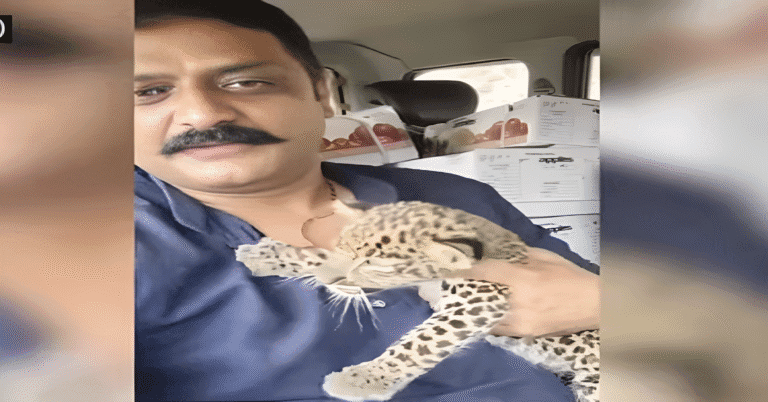

A recent incident in Himachal Pradesh has sparked debate on social media about when and how humans should intervene in the lives of wild animals. An Indian Forest Service (IFS) officer publicly criticised a local resident for rescuing a leopard cub and driving it around in his car, calling the decision “well-intentioned but misguided” and warning that such actions can often do more harm than good.
The Incident in Kotkhai (IFS Officer Rescuing Leopard Cub)
The controversy began when Ankush Chauhan, a resident of Kotkhai in Himachal Pradesh, reportedly came across a young leopard cub. Believing the animal to be abandoned or in distress, he decided to take it to the divisional forest officer (DFO) in Theog.
On the way, Chauhan filmed the cub sitting in the passenger seat of his car. In the video, which quickly went viral on social media, the small leopard is seen peering out of the window and crying, while Chauhan attempts to console it. The sight of a wild animal inside a passenger vehicle drew mixed reactions online—some found it endearing, while others criticised the act, citing potential risks to both the animal and humans.
IFS Officer’s Warning
IFS officer Parveen Kaswan was among those who strongly disapproved of the rescue attempt. Taking to X (formerly Twitter), Kaswan stated that while the act may appear “cute” and “well-intentioned” to some, it was “not a good decision” from a wildlife conservation perspective.
“Rescues should be the last resort,” Kaswan wrote. “First, such cat species cubs should be secured wherever they are found. Secure and let the mother come and take them. If there are multiple failures, then rescue as a last resort. This is what we do.”
Kaswan stressed that in most cases, wild mothers—especially those of big cats—leave their cubs temporarily while hunting or scouting for food. Removing the cub from its original location can severely reduce its chances of being reunited with its mother.
The Importance of Minimal Human Intervention
Kaswan explained that human interference often disrupts the natural processes that allow wild animals to survive and thrive. Raising a wild cub without its mother is an enormous challenge, even for trained professionals.
In the worst-case scenario, he warned, a cub separated from its mother could die within a month or two due to a lack of proper nutrition. In the best-case scenario, the cub might survive but would likely spend the rest of its life in captivity. This is because cat species—such as leopards, tigers, and lions—learn essential hunting and survival skills from their mothers during their early years. Without these lessons, a cub cannot be successfully released back into the wild.
Kaswan’s comments reflect a well-established principle in wildlife conservation: nature should be allowed to take its own course unless there is clear evidence of danger or abandonment.
Social Media Reactions
The post by Kaswan generated significant discussion online, with many users agreeing with his views and urging others to think twice before intervening in wildlife matters.
One user wrote, “Couldn’t agree more. Nature should be allowed to take its own course. Intervention should be the lender of last resort.”
Another commented, “A very bad decision. He should have waited for the mother and informed police or forest officers to ensure the safety of the cub.”
Some went a step further, accusing Chauhan of using the incident for social media attention. “All in the name of making a video and posting it. When will this brainless behaviour stop?” one frustrated user remarked.
Wildlife experts consistently emphasise that the correct course of action upon finding a wild animal—especially a young one—is to contact the local forest department immediately.
In most Indian states, trained forest officials have protocols in place to monitor such situations. These include:
Observation from a Distance – Officials watch from a hidden location to see if the mother returns.
Temporary Containment – If the area poses immediate danger (e.g., near roads or human settlements), the cub may be moved a short distance away while still allowing for the mother’s return.
Rescue as a Last Option – Only if it’s confirmed that the mother will not return, or if the cub is injured, is a full rescue and relocation carried out.
This cautious approach minimises unnecessary human contact, which can lead to stress, injury, or behavioural issues in wild animals.
ALSO READ- Bhumi Pednekar Launches ₹200 Premium Water Brand
While it’s natural for people to want to “help” an animal that appears to be alone or in distress, these good intentions can backfire in several ways:
Separation from the Mother – The mother might be nearby, watching from a safe distance, and could return if left undisturbed.
Increased Stress for the Animal – Wild animals perceive humans as threats, and handling them can cause intense fear and stress.
Risk of Injury or Disease – Both humans and animals can be injured during such encounters. Additionally, wild animals can carry diseases that can be transmitted to humans and vice versa.
Loss of Survival Skills – Animals raised in human care from a young age rarely develop the skills they need to live independently in the wild.
Kaswan’s criticism highlights a broader message about wildlife conservation: coexistence does not mean interference. Human curiosity and compassion must be balanced with scientific understanding and respect for natural processes.

With increasing encroachment into wildlife habitats, encounters between humans and wild animals are becoming more common in India. This makes it all the more important for the public to know when and how to respond.
Educational campaigns by forest departments and NGOs often stress that wildlife should be observed from a distance, not handled, and that professional help should be sought in any suspected rescue situation.


 By
By