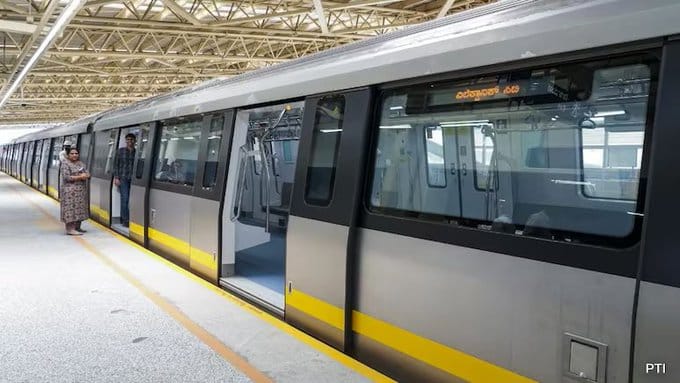
Namma Metro’s Yellow Line- Bengaluru marked a significant milestone in its urban transport development today, as Prime Minister Narendra Modi officially inaugurated the much-anticipated Yellow Line of Namma Metro. The new corridor, spanning 19.15 kilometers from RV Road in South Bengaluru to Bommasandra in the east, is expected to dramatically improve the city’s connectivity, ease congestion at key traffic choke points, and reduce travel time for lakhs of commuters.
Constructed at a cost of ₹7,160 crore, the Yellow Line features 16 elevated stations and will serve as a vital link between bustling residential neighborhoods, major IT hubs, and industrial areas. According to authorities, this line could cater to up to eight lakh commuters every day once it reaches full operational capacity.
A Direct Link to Bengaluru’s Employment Hubs
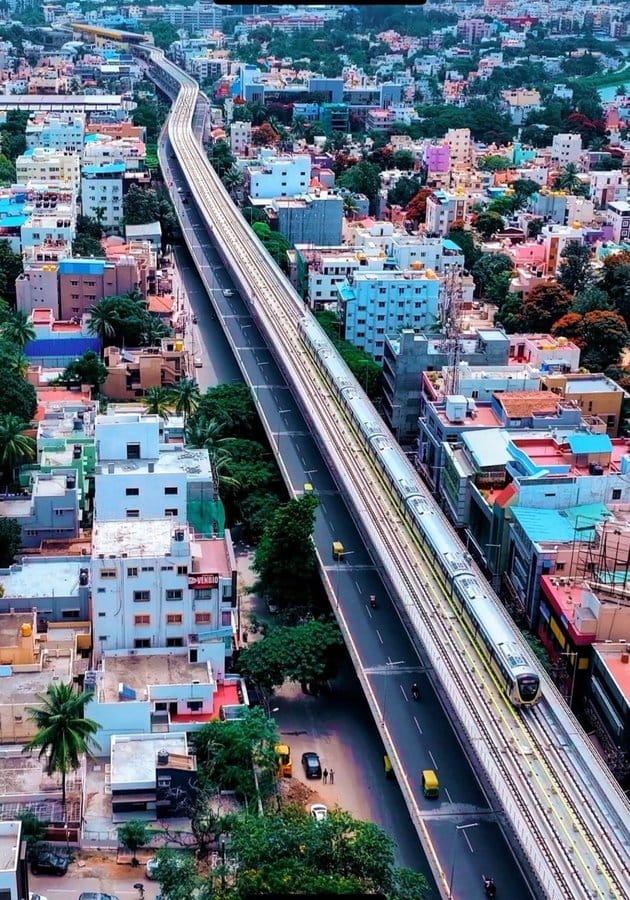
The Yellow Line passes through some of the city’s busiest and most economically significant areas. It directly connects RV Road to Central Silk Board Junction, BTM Layout, HSR Layout, and the Electronic City region, one of India’s largest IT hubs.
For decades, Electronic City has been home to major technology companies like Infosys, Wipro, Biocon, and TCS, drawing tens of thousands of employees from across Bengaluru. But the lack of direct mass-transit connectivity meant that employees had to depend on road transport, leading to long, stressful commutes—often taking 1.5 to 2 hours during peak traffic.
And there it goes! 🚇
The long-awaited Yellow Line from RV Road to Bommasandra is now open, flagged off by PM Shri @narendramodi Ji.
A big win for Bengaluru – especially for those travelling daily from residential areas to Electronic City and beyond. No more wasting hours in… pic.twitter.com/nnlsvP4OnJ
— Tejasvi Surya (@Tejasvi_Surya) August 10, 2025
With the Yellow Line, that scenario is set to change. The corridor links residential neighborhoods in the south with tech parks and manufacturing zones like Bommasandra Industrial Area, where many factories and small-scale industries operate. By providing a seamless connection, the metro is expected to significantly reduce dependency on private vehicles, in turn lowering traffic congestion and pollution levels in the city.
Relief for Bengaluru’s Traffic Woes
One of the most immediate benefits of the Yellow Line will be the decongestion of Silk Board Junction—long infamous as one of Bengaluru’s worst traffic bottlenecks. The intersection, located at the meeting point of several arterial roads, witnesses massive gridlocks during rush hour, affecting not only commuters heading to Electronic City but also those traveling toward HSR Layout, BTM, and Outer Ring Road.
By offering a reliable, traffic-free alternative, the Yellow Line is expected to cut peak-hour travel time to Electronic City by half—from nearly two hours by road to just around 45 minutes. This could also improve productivity and quality of life for daily commuters, who often spend hours stuck in traffic each day.
Metro Timings and Operations
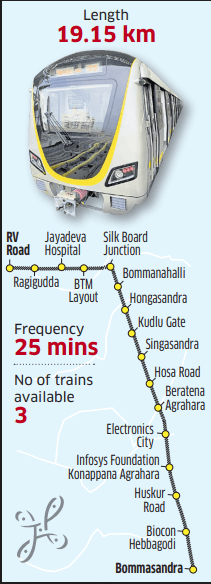
Commercial services for the Yellow Line will begin on Monday, August 11. Initially, three driverless trains will operate on the route at 25-minute intervals between 5:00 am and 11:00 pm. Officials have announced that more trains will be added by the end of the month, improving frequency to every 20 minutes.
These trains will be equipped with modern amenities and safety systems, ensuring a comfortable journey for passengers. Being fully elevated, the line also offers scenic views of the city’s skyline and neighborhoods during the ride.
Fares for the Yellow Line will follow the existing Namma Metro pricing structure, ranging from ₹10 to ₹90 depending on the distance traveled.
RV Road to Jayadeva: ₹10
Whitefield (Purple Line) to Bommasandra (Yellow Line): ₹90 (longest possible stretch)
This affordable pricing is aimed at encouraging more people to opt for the metro over personal vehicles or app-based cabs, both to save time and reduce travel costs.
List of Yellow Line Stations
RV Road – Interchange with Green Line
Ragigudda
Jayadeva Hospital – Future interchange with Pink Line; possibly the tallest metro station in the city
BTM Layout
Central Silk Board
HSR Layout
Oxford College
Hongasandra
Kudlu Gate
Singasandra
Hosa Road
Electronic City-I
Konappana Agrahara
Huskur Road
Hebbagodi
Bommasandra
This route has been strategically designed to pass through high-density residential and employment zones, ensuring high passenger demand from the very start of operations.
The time-saving potential of the Yellow Line is one of its strongest selling points. For example, the journey from RV Road to Electronic City, which can take up to two hours by road during rush hour, will now take less than 45 minutes. Similarly, commuters from Bommasandra Industrial Area will be able to reach the central parts of Bengaluru much faster, bypassing traffic-prone stretches entirely.
Phase 3 Expansion and Broader Impact
The inauguration event also saw Prime Minister Modi flag off the Bengaluru–Belagavi Vande Bharat Express and lay the foundation stone for Phase 3 of Namma Metro. This new phase will involve a 44.65-km expansion worth ₹15,610 crore, and is projected to benefit around 25 lakh residents in southern Bengaluru.
The event was held at the International Institute of Information Technology, Bengaluru (IIIT-B) campus in Electronics City, highlighting the metro’s close association with the city’s tech community.
Economic and Social Benefits
Urban planners and transport experts have hailed the Yellow Line as a “game-changer” for the city’s southern transport network. The improved connectivity is expected to:
Boost economic activity by improving access to employment hubs and industrial areas.
Encourage public transport use, thereby reducing reliance on private vehicles.
Lower pollution levels by cutting down vehicular emissions.
Improve road safety by reducing traffic congestion and the potential for accidents.
In the long term, better connectivity could also drive real estate development along the corridor, increasing property values and spurring new residential and commercial projects.
ALSO READ- SS Rajamouli Unveils Poster of Mahesh Babu’s Upcoming Film
A Step Toward a Smarter Bengaluru
For a city often criticized for its traffic snarls, the inauguration of the Yellow Line is a positive step toward a more efficient, sustainable urban transport system. Along with other metro lines currently under construction, Bengaluru is steadily building a network that will make commuting faster, cheaper, and far less stressful.
As more stretches of Namma Metro become operational, the hope is that public transport will become the preferred mode of travel for a majority of the city’s population—helping Bengaluru retain its status as India’s “Silicon Valley” while also improving the quality of life for its residents.
The Yellow Line’s launch is not just about adding another metro corridor; it’s about reshaping the way Bengaluru moves. With reduced travel times, improved connectivity to key economic zones, and relief for overburdened roads, this project promises to be a true transformational upgrade for the city. And as Phase 3 moves forward, the vision of a fully integrated, high-capacity metro system for Bengaluru is coming closer to reality.


 By
By