

Delhi blast: Based on the CCTV footage from Delhi Police Special Cell, which analysed the explosion of an i20 car in North West Delhi, it was concluded that the vehicle entered Sunheri Masjid parking at 3:19 PM and left it around 6:48 pm after three hours of parking. Four minutes later, at 6.52 pm, the car exploded at the Subhash Marg traffic signal.

New Delhi | Delhi blast
An eye-opening revelation has emerged from the probe into the car blast here on Wednesday near Railway Cantonment Station, close to the Red Fort Metro Station. The Hyundai i20 car that exploded had been parked in a lot near the Golden Mosque for about three hours before, according to an analysis of footage from surveillance cameras of Delhi Police around the blast site.
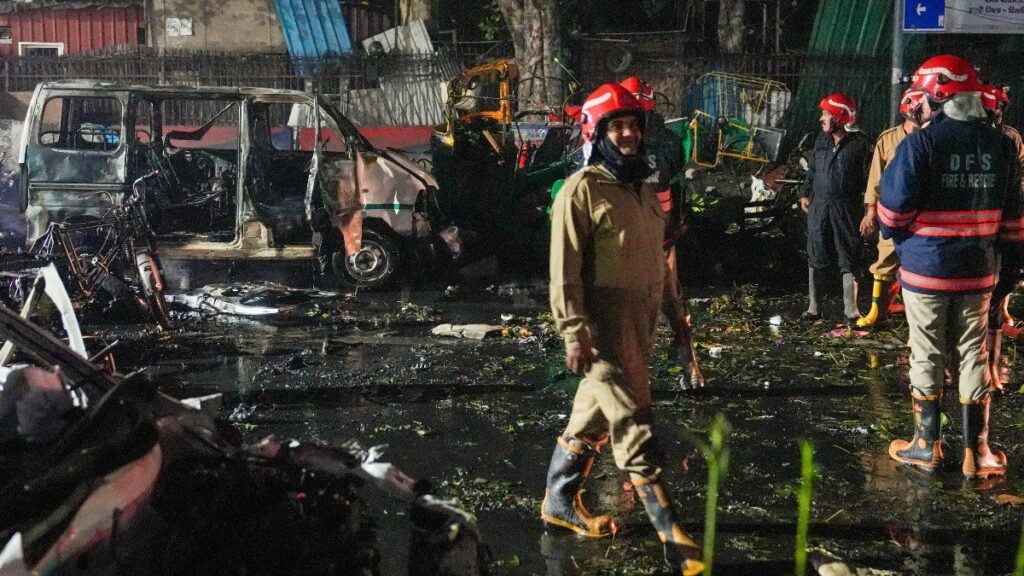
Around 3:19 p.m. on November 10, the vehicle entered and exited the lot, Delhi Police say, at 6:48 p.m. Four minutes later, at 6:52 p.m., the vehicle exploded at the Subhash Marg traffic light, engulfing several other nearby vehicles. Eight people died and twenty were injured in the tragedy.
An image of an i20 car travelling on the road close to the Golden Mosque, taken shortly before the explosion, was made public by the Delhi Police Special Cell. The car was travelling slowly at a traffic signal on Netaji Subhash Chandra Bose Marg close to the Red Fort when a powerful explosion occurred in the trunk.
Delhi blast: The blast was so strong that it shattered and ignited the windows of multiple vehicles in the vicinity. Additionally, the glass at the Red Fort Metro Station broke. The vehicle was registered with Haryana’s Gurugram North Railway Station.
Its number, HR 26 7624, is registered under the name of a man named Muhammad Salman, who is being held by the police and is being questioned. A connection to Pulwama has also been uncovered by the investigation. Tariq, a resident of Jammu and Kashmir, purchased the I-20 car from Salman.
The i20 vehicle was purchased and sold multiple times
This vehicle was purchased and sold multiple times. The car was bought and sold using fictitious documents, according to sources. Because the car that exploded was given a Rs 1723 challan for improper parking in Faridabad at 12 am on September 15th of this year, security agencies are also suspicious that this is a routine incident. The fact that Jammu and Kashmir and Faridabad police seized a significant amount of hazardous chemicals used in the production of explosives in Faridabad late on the evening of November 9th further raises suspicions in this case.
The Faridabad terror module is being wired
Security agencies believed that the Delhi strikes were somehow related to the recovery of a haul of chemicals. In a joint operation, the police had seized 2,900 kg of explosives used for IED-making and huge cache of arms following which it busted an international terrorist module having links with Jaish-e-Mohammed (JeM) terror accused and Ansar Ghazwat-ul-Hind (AGuH).