
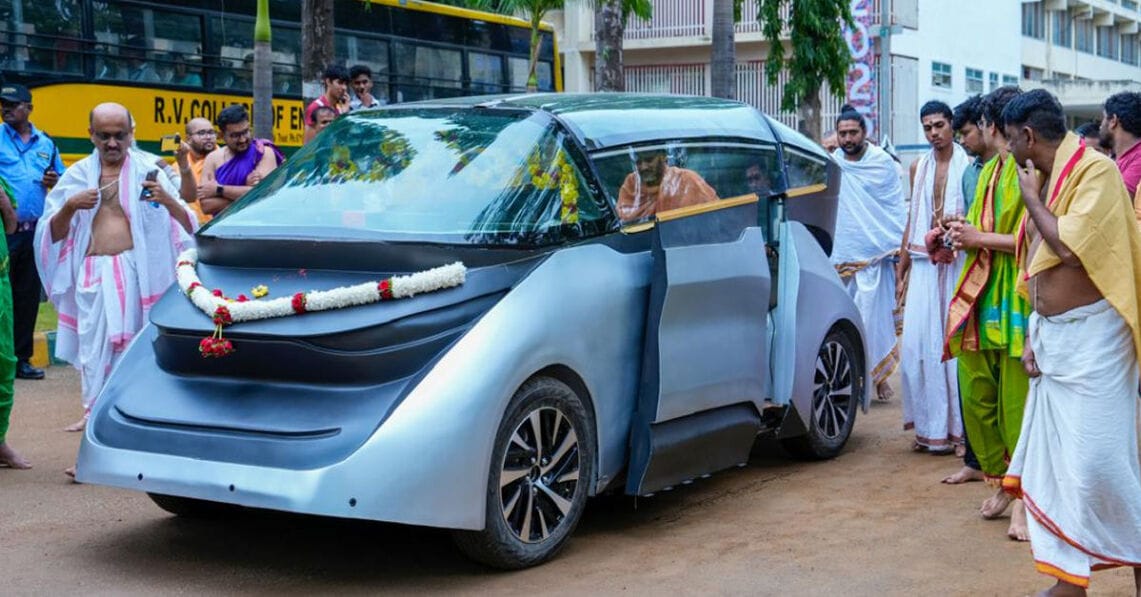
A fascinating video showing a driverless car moving smoothly around a college campus in Bengaluru has gone viral on social media, drawing huge attention and curiosity from viewers across India. The clip has sparked conversations about the future of autonomous driving in the country and the innovative minds working behind the scenes to make it possible.
The Viral Video That Caught Everyone’s Attention
In the now-viral video, a car can be seen driving around the campus of RV College of Engineering without anyone behind the wheel. Inside the vehicle sits a calm and composed seer, Sri Satyatmatheertha Swamiji of the Uttaradi Matha, along with a few others. The autonomous car glides smoothly through the college roads, amazing onlookers who quickly shared the video online.
Table of Contents
It was later confirmed that Sri Satyatmatheertha Swamiji was visiting RV College of Engineering and took a short joyride in the concept driverless vehicle. The seer appeared delighted with the experience and praised the innovative work of the students and researchers behind the project.
A Collaboration of Top Institutions
The driverless car is the result of a collaboration between Wipro, the Indian Institute of Science (IISc), and RV College of Engineering. The project operates under the WIRIN (Wipro-IISc Research and Innovation Network) programme, a joint initiative that promotes cutting-edge research in artificial intelligence (AI), robotics, and human-machine interaction.
The WIRIN programme aims to create next-generation technologies through innovation, design, and real-world application. It brings together the academic excellence of IISc, the research expertise of Wipro, and the engineering skills of RV College students to build technologies that could revolutionize mobility in India.
The Goal: A Smarter and Safer Autonomous Vehicle
According to sources involved in the project, the driverless car is still in its testing and development phase. A formal launch is expected in the coming months once the system is fine-tuned for Indian conditions.
The research team is currently working on mapping and studying Indian roads to make the car fully capable of handling the country’s diverse and often challenging traffic environments. The goal is to ensure smooth navigation, obstacle detection, and safety under real-world conditions.
The collaboration covers a wide range of research areas, including:
- Autonomous Systems: imaging, image processing, and computer vision.
- Artificial Intelligence and Machine Learning: development of deep learning algorithms to improve real-time decision-making.
- Data Science and Cybersecurity: ensuring safe data handling and system integrity.
- Smart Materials and Emerging Technologies: enhancing vehicle design and energy efficiency.
- Disruptive Design and Manufacturing: creating scalable solutions for the automotive industry.
India’s Growing Focus on Driverless Technology
Sri Sri Satyatmateertha Swamiji of Uttaradimath travelling in Driverless Car At RV College.Projected Funded by Wipro Engineering,Jointly Developed By Wipro,IISc & RV College Of Engineering Bengaluru…🙂👌👏
— Adarsh Hegde (@adarshahgd) October 27, 2025
Superb Technology. 🤘@anandmahindra @elonmusk @nikhilkamathcio . pic.twitter.com/m3khFWgEQU
India is slowly but steadily joining the global race toward autonomous mobility. Apart from the WIRIN project in Bengaluru, other Indian institutions are also contributing to this technological shift.
For instance, the Indian Institute of Technology (IIT) Hyderabad is actively developing autonomous navigation systems. Their team has built prototype vehicles for off-road uses such as agriculture and mining, where driverless mobility can improve safety and efficiency. These prototypes are already being used to ferry people and materials within the IIT Hyderabad campus.
Such projects highlight India’s potential to become a hub for autonomous vehicle technology in the coming years.
Global Developments in Driverless Cars
While India is still in the experimental stage, countries like the United States are moving closer to commercializing driverless cars. Tesla CEO Elon Musk recently announced plans to launch driverless ride-hailing services in California and Texas. Tesla has already received initial approvals from California authorities to begin pilot testing.
READ ALSO- Odisha Launches Rs 50,000-Crore Maritime Vision to Boost Port Capacity to 500 Million TonnesGlobal tech giants and automakers are racing to make self-driving technology mainstream. However, experts believe India’s progress will depend on developing cost-effective technology that can handle local traffic patterns, weather conditions, and infrastructure challenges.
The viral video of the Bengaluru driverless car has inspired widespread excitement about India’s technological future. What began as a college-level innovation project has now caught the nation’s attention and raised hopes about how homegrown talent can lead the next wave of transportation innovation.
As the project continues to evolve, the partnership between Wipro, IISc, and RV College of Engineering could mark a major milestone in India’s journey toward autonomous mobility. The initiative not only showcases India’s growing capabilities in AI and robotics but also reflects how collaboration between academia and industry can drive real-world impact.
With projects like these, the day may not be far when India’s roads see locally developed driverless cars operating safely and efficiently, blending innovation with the country’s unique driving landscape.