
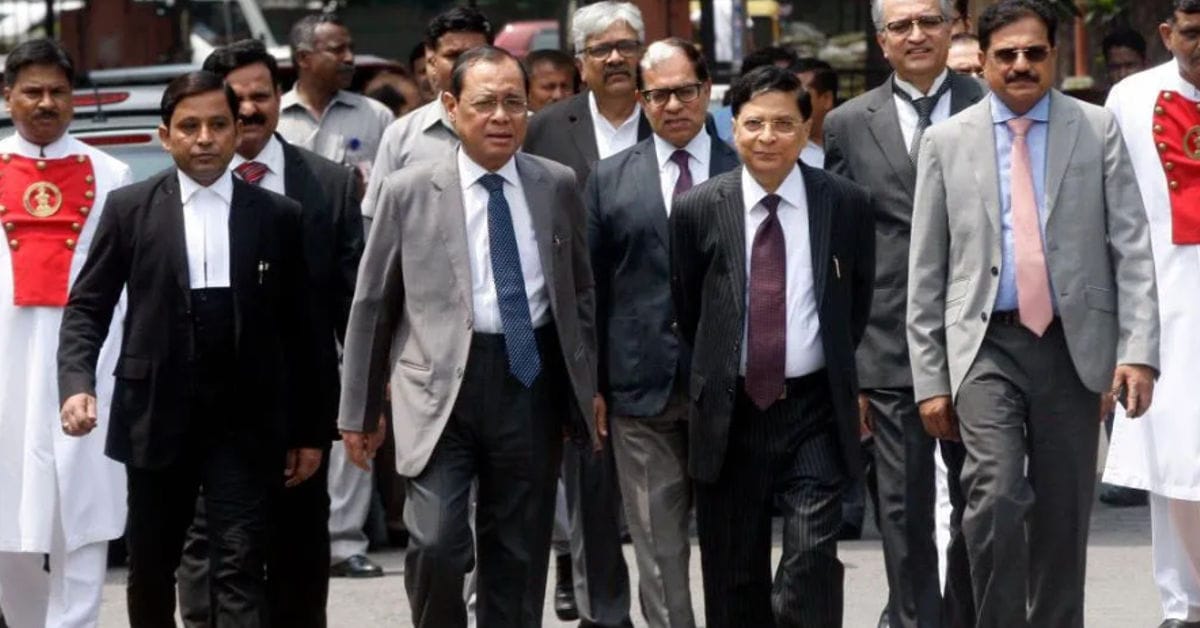
In September 2021, a photograph from the Indian Supreme Court went viral. It showed then Chief Justice NV Ramana flanked by four female judges, marking the highest-ever number of women serving together in India’s top court. Many hoped this signaled a turning point toward greater gender balance in India’s judiciary.
But four years later, that hope seems to have vanished. As lawyer Sneha Kalita calls it, the Supreme Court has returned to being “a men’s club.”
Where Are the Women Judges?
Table of Contents
Three of the female judges in that historic photo – Justice Indira Banerjee, Justice Hima Kohli, and Justice Bela M Trivedi – have since retired. No new women have been appointed to the Supreme Court since then. As of now, Justice BV Nagarathna is the sole woman serving on the 34-member bench.

“This is alarming. It’s nothing short of catastrophic,” says Sneha Kalita, part of a group of female advocates pushing for fair representation in the judiciary. Since the Supreme Court began in 1950, it took nearly 40 years to appoint the first woman judge, Justice Fathima Beevi, in 1989. Over 75 years, only 11 of 287 judges have been women, making up just 3.8%.
With only one woman in the Supreme Court today, representation is almost zero. The issue is even worse in high courts, where only 103 of 773 judges are women, and at least four high courts have no female judges at all.
Recent Appointments Worsen the Situation
This gender imbalance came into sharp focus when the Supreme Court collegium recently made new appointments. The collegium, which includes the chief justice and four senior judges, had two vacancies to fill in the Supreme Court. Observers expected it would help correct the gender gap. Instead, two male high court judges were promoted.
Reports revealed that at least three female high court judges were more senior than one of the men chosen. Similarly, in recent high court appointments, gender imbalance continued: Bombay High Court received 14 new judges, with only one woman among them, and Allahabad High Court’s proposed list of 26 new judges included just five women.
The Supreme Court Bar Association (SCBA) voiced “deep disappointment” and “grave concern” over the growing disparity.

Why Gender Balance Matters
SCBA president Vikas Singh highlighted an important point: in lower courts, where appointments are based on written exams and interviews, women make up 40% of judges. But in the higher judiciary, where selections happen through collegium recommendations, women account for less than 10%.
Senior lawyer Madhavi Divan supports this intervention. “It’s not just a women’s problem. It reflects on us as a society,” she says.
Critics often argue that not all women judges are more gender-sensitive than their male counterparts. Still, senior advocate Jayna Kothari stresses that India’s diversity should reflect in the judiciary. “The Supreme Court serves the entire country. It considers regional diversity. So why not gender diversity?” she asks.
READ ALSO- Controversy Erupts as ‘Nude Party’ Planned in Chhattisgarh Capital, Six Held
Studies show that having women on the bench leads to more balanced decisions. Moreover, their presence helps prevent gender-insensitive remarks during court proceedings.
How to Improve Representation?
A common suggestion is to implement a quota system that reserves seats for women judges. Supporters argue this would force the judiciary to fix its gender imbalance. However, critics claim quotas could compromise merit.
Sneha Kalita strongly disagrees with this criticism. She explains that women in the legal profession often juggle demanding careers with family responsibilities. “Many women are far more meritorious than their male colleagues,” she insists. “This is not about merit but discrimination.”
Jayna Kothari argues that gender imbalance should be seen as a public issue, not merely a women’s issue. She proposes a realistic target of reaching 30% female representation in the next five years, as a step toward 50% parity.
Why It Matters for the Future

Having more women in the Supreme Court and high courts isn’t just symbolic. It plays a key role in encouraging more women to enter and stay in the legal profession.
“If the top judiciary doesn’t reflect us, why would women continue to work hard in this field?” Kothari asks.
Without better representation, many women may feel their hard work won’t lead to leadership roles. Increasing the number of women judges would not only improve gender balance but also help the judiciary deliver fairer and more thoughtful judgments, reflective of the entire nation.