
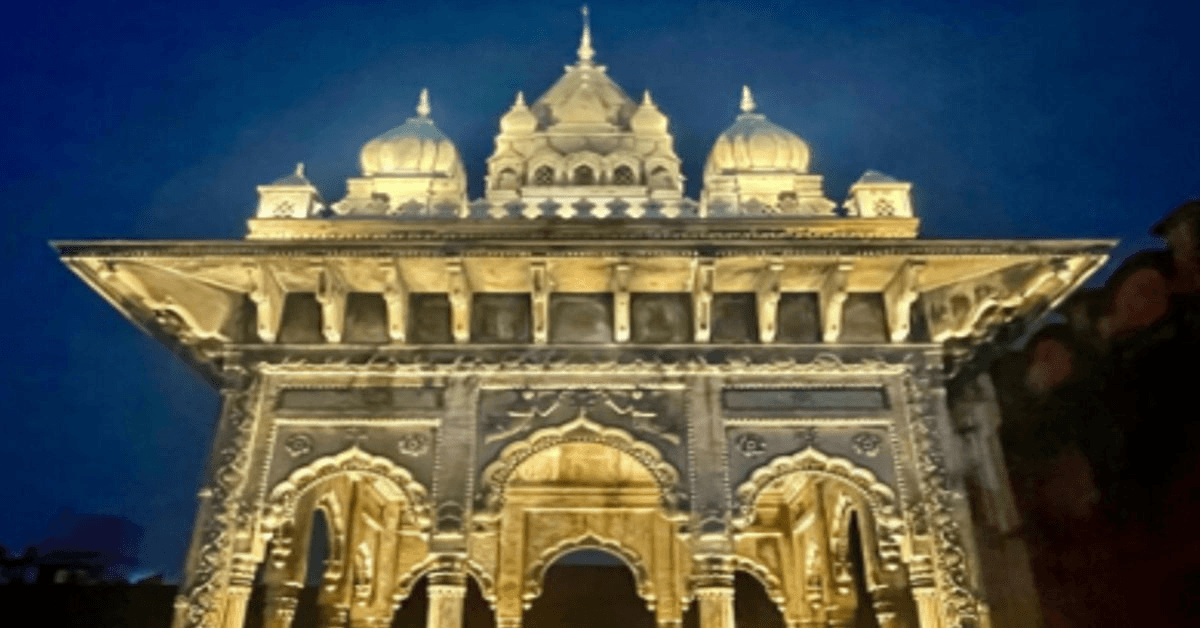
Indian City Bright Like Paris- As an air-conditioned bus moves through the busy streets of Kolkata, Sujoy Sen, a tour leader, points out various historical landmarks. The city’s colonial buildings, temples, churches, and homes of freedom fighters paint a picture of Kolkata’s rich cosmopolitan history. But this isn’t an ordinary heritage tour — it takes place after sunset, focusing not just on the architecture but on how the buildings are lit up.
The Kolkata Illumination Project is the newest addition to the city’s growing list of heritage tours. It highlights how beautiful Kolkata’s neglected heritage buildings can look when illuminated at night.
A Spark of Inspiration(Indian City Bright Like Paris)
Table of Contents
Sujoy Sen came across a newspaper article about local enthusiasts lighting up Kolkata’s heritage structures. Curious, he visited several sites himself. “I was stunned,” he recalls. “I have seen Paris by night. I didn’t realise Kolkata could be like that also. I wanted other people to see it as well.”
For residents like Himanjali Sankar, who was born and raised in Kolkata, the tour was a revelation. “The buildings are familiar, but the illumination changes them. It’s like they are coming alive, reclaiming their grandeur,” she says.
The Simple Idea Behind the Project
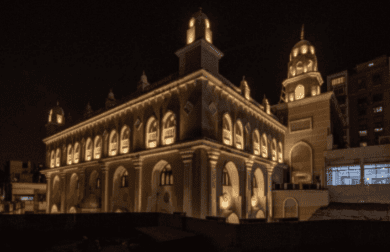
The initiative was started by a loose group of citizens calling themselves Kolkata Restorers. “It’s not a formal organisation,” says Mudar Patherya, who leads the effort. “There’s no committee, no president. It’s just a WhatsApp group.”
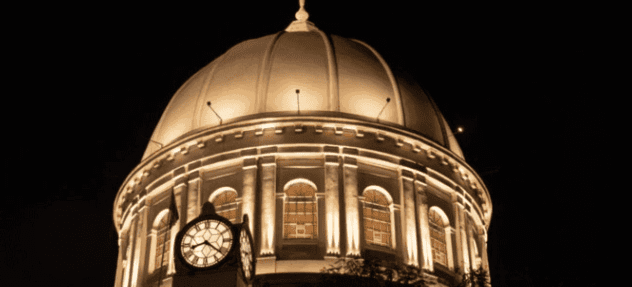
It all began when Patherya discovered an old market with a grand dome and a broken clock bearing Bengali numerals. He raised money from friends to paint the dome. But he soon realised that while it looked good during the day, it went unnoticed at night. So he gathered more funds to illuminate it.
With extra money left over, he also lit up a temple hidden in a historic neighborhood. The temple’s intricately carved stone facade came alive under the soft yellow glow of LED lights, revealing its hidden charm.
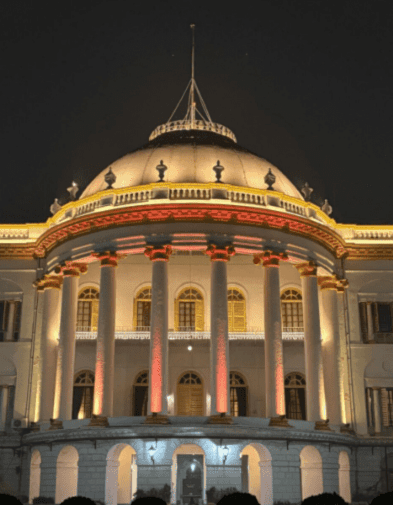
Within a short time, Patherya expanded the project to include the Geological Survey of India building and Raj Bhavan, the governor’s mansion, once home to the British viceroy.
A Simple but Effective Model
The model is straightforward. “It’s your property, my lights,” explains Patherya. “The owners only pay for the electricity, and I calculate the cost in advance.”
Lighting designer Suyash Narsaria worked to get the intensity just right. “We reduced the wattage, repositioned the lights, and used layers to highlight columns, railings, and murals,” he says.
But as the project expanded, an unexpected challenge appeared. The illumination didn’t just highlight the beauty of the buildings — it also revealed their disrepair. Restoration became necessary before lighting could be installed.
Restoring More Than Just Lights
A perfect example is Hogg Market, a 150-year-old Gothic structure where one can find everything from parrots to Bandel cheese and Christmas cakes from a Jewish bakery. The iconic clock tower had stopped working, and parts of the structure were decaying. The roof was damaged, and the floorboards had rotted.
Patherya sought out Swapan Dutta, a fourth-generation clock repairer known as ‘Ghari-babu’ or Clock-man. Mr. Dutta’s family had a long history of repairing British-era clocks. He was excited to work on the Hogg Market clock, which chimes every fifteen minutes with a different tune.
“These clocks had stopped working for years,” says Dutta. “We have to examine them, calculate the missing parts, and reconstruct everything.” He had already repaired more than half a dozen clocks for Patherya, including those in churches, synagogues, and markets.
A Renewed Sense of Pride
What Kolkata Restorers are truly working to restore is not just buildings, but pride in the city’s heritage. Once the capital of British India, Kolkata’s fortunes have declined since independence. Its unique mix of neoclassical, Gothic, and Art Deco architecture is fast disappearing as old homes are replaced by apartments and malls.
“Most people talk about how Kolkata is not keeping up with the times,” says Himanjali Sankar. “It is wonderful to see people excited about the city’s architecture.”
Heritage is often seen as expensive and low priority, especially in a city keen to attract business. But Patherya’s vision is different — he believes heritage restoration can be citizen-led and crowdsourced.
READ ALSO- Lashkar-e-Taiba Rebuilding Markaz Taiba After Operation Sindoor
An apartment in a posh Kolkata complex can cost around 150 million rupees (about $1.7m). Yet with just 22 million rupees, Kolkata Restorers have restored 92 buildings, 8–9 clocks, and 1,300 tombstone plaques.
A Bright Future Ahead
During the “Kolkata by Night” tour, Patherya points to a whole block lit up by his group’s effort — imposing red-brick neoclassical buildings glowing warmly in yellow light.
“I want to get to 200 buildings,” he says. “Then Kolkata will be one of the most wondrous cities at night in the country. The architecture is already there.”
With a growing team of passionate volunteers, the Kolkata Illumination Project is shining a new light — literally — on the city’s forgotten treasures, helping residents rediscover the charm of their heritage.