
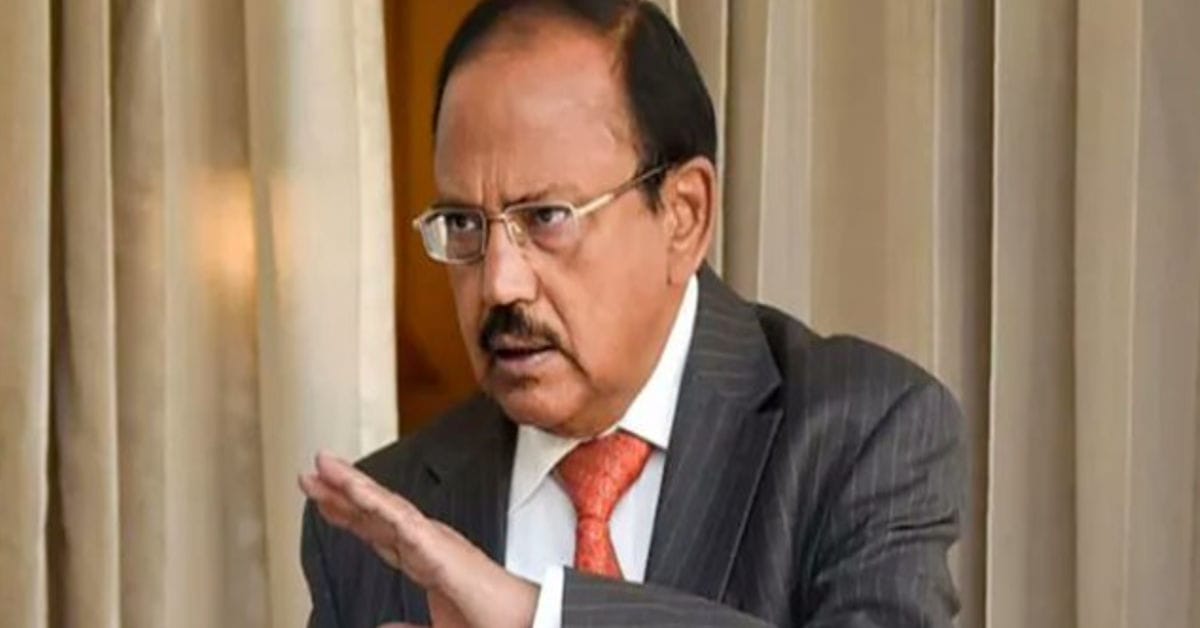
Prime Minister Narendra Modi’s recent visit to China for the Shanghai Cooperation Organisation (SCO) summit has once again brought India’s role in the powerful regional bloc into sharp focus. Modi’s meeting with Chinese President Xi Jinping revolved around strengthening bilateral ties at a time when India faces increasing challenges from shifting global dynamics—particularly with the United States imposing steep tariffs on Indian goods.
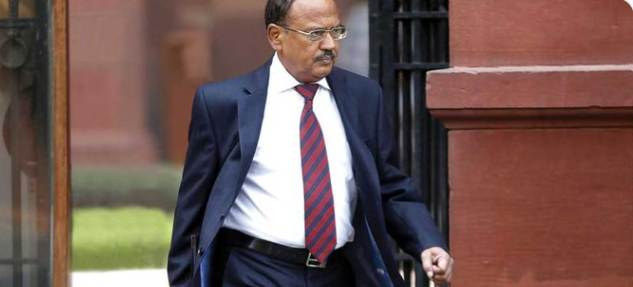
But Modi’s presence in Beijing also recalls a defining moment from five years ago when India’s National Security Advisor (NSA), Ajit Doval, made headlines for his uncompromising stand on national sovereignty. The incident, remembered as the “SCO Walkout of 2020,” not only underscored India’s zero-tolerance approach to territorial provocations but also reinforced Doval’s reputation as the country’s most formidable intelligence strategist.
The Walkout That Shook the SCO
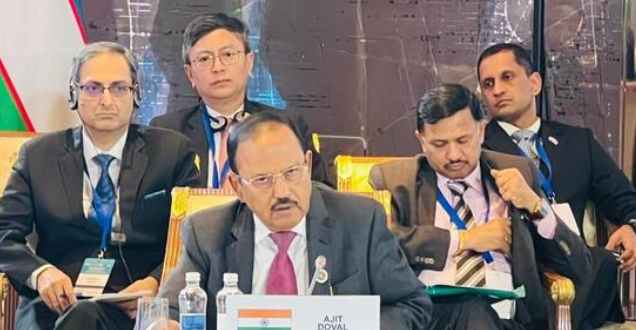
The episode dates back to September 2020, a time when international diplomacy had shifted online due to the COVID-19 pandemic. The SCO National Security Advisors’ meeting was being held virtually, with Russia presiding as chair.
During the session, Pakistan’s representative, Dr. Moeed Yusuf, unveiled a newly issued political map. This map outrageously claimed Jammu and Kashmir as well as Junagadh—both integral parts of India—as Pakistani territory. The act violated one of the SCO’s most basic principles: bilateral disputes must not be raised in multilateral forums.
India lodged an immediate objection. Russia, as chair, repeatedly asked Pakistan to remove the provocative display. But Yusuf refused to back down. That’s when Ajit Doval made his move.
Without hesitation, India’s NSA walked out of the meeting. His exit sent a crystal-clear message: India would never legitimize attempts to question its territorial integrity.
An official familiar with the matter described Pakistan’s action as “a blatant violation of the SCO Charter and against all established norms of safeguarding the sovereignty and territorial integrity of SCO Member States.” Russia later confirmed it did not support Islamabad’s stunt. Nikolai Patrushev, Secretary of the Russian National Security Council, even praised Doval’s firm decision to walk away.
The incident instantly made global headlines, adding another chapter to the storied career of India’s “super spy.”
The Man Behind the Walkout
For those who follow India’s national security closely, Doval’s dramatic exit was hardly surprising. Known for his sharp intellect, unflinching courage, and years of intelligence expertise, Doval has built a career on making tough calls that protect India’s sovereignty.
Born in 1945 in Garhwal (now Uttarakhand), Ajit Doval joined the Indian Police Service (IPS) in 1968, and by 1972, he was handpicked into the Intelligence Bureau (IB). What followed was a career that reads like the plot of a high-stakes espionage novel.
Undercover in Pakistan (1971–1978)
For nearly seven years, Doval lived undercover in Pakistan, posing as a Muslim cleric. During the 1971 India-Pakistan war, his intelligence inputs played a crucial role in India’s strategic decisions. Few in India’s security establishment have spent as much time on the ground in hostile territory as he has.
Doval’s skills weren’t confined to foreign operations. He was instrumental in negotiating peace during domestic insurgencies. In the 1980s, he engaged with Mizo rebel leaders, laying the groundwork for the Mizo Peace Accord of 1986, which brought stability to the northeast.
During Operation Black Thunder (1988), he infiltrated the Golden Temple complex in Amritsar disguised as an ISI operative. His intelligence helped security forces flush out militants with minimal bloodshed, a stark contrast to the earlier Operation Blue Star.
Kandahar Hijacking (1999)
Perhaps one of the most harrowing episodes of his career was the Indian Airlines Flight IC-814 hijacking. The aircraft was taken to Kandahar, Afghanistan, by terrorists demanding the release of jailed militants. Doval was part of the core negotiating team. Although India had to release terrorists under immense pressure, his presence ensured that all hostages returned alive.
Rescuing Nurses from ISIS (2014)
In 2014, when 46 Indian nurses were trapped in Iraq during an ISIS offensive, Doval personally coordinated their rescue. His direct involvement and swift diplomacy brought them home safely, cementing his reputation as a man of action who doesn’t shy away from taking personal responsibility.
The Surgical Strikes (2016)
As NSA under the Modi government, Doval oversaw the planning and execution of the surgical strikes across the Line of Control in Pakistan-occupied Kashmir in 2016. These strikes, carried out after the Uri terrorist attack, marked a new era in India’s counter-terrorism strategy—one where India showcased its willingness to act beyond its borders to defend national interests.
Against this backdrop, Doval’s walkout from the SCO meeting in 2020 wasn’t just a reaction to a provocative map. It was a carefully calculated act of symbolism. It reinforced India’s message that territorial integrity is non-negotiable, regardless of the forum or circumstances.
The move also highlighted India’s growing assertiveness on the global stage. Rather than simply lodging diplomatic protests, Doval demonstrated that India would take visible, decisive steps—even if it meant walking away from a powerful multilateral platform.
Legacy of a ‘Super Spy’
Today, Ajit Doval continues to shape India’s national security and strategic vision. His life’s work reflects a unique blend of intelligence expertise, diplomatic tact, and operational daring. From undercover missions in Pakistan to safeguarding India’s interests in multilateral forums like the SCO, Doval’s career embodies the principle that national security is not just about defense—it’s about sending clear messages when sovereignty is at stake.
As Prime Minister Modi strengthens India’s role in the SCO, the memory of Doval’s 2020 walkout remains a reminder of the weight India carries in the organization—and the determination with which it defends its national interests.