
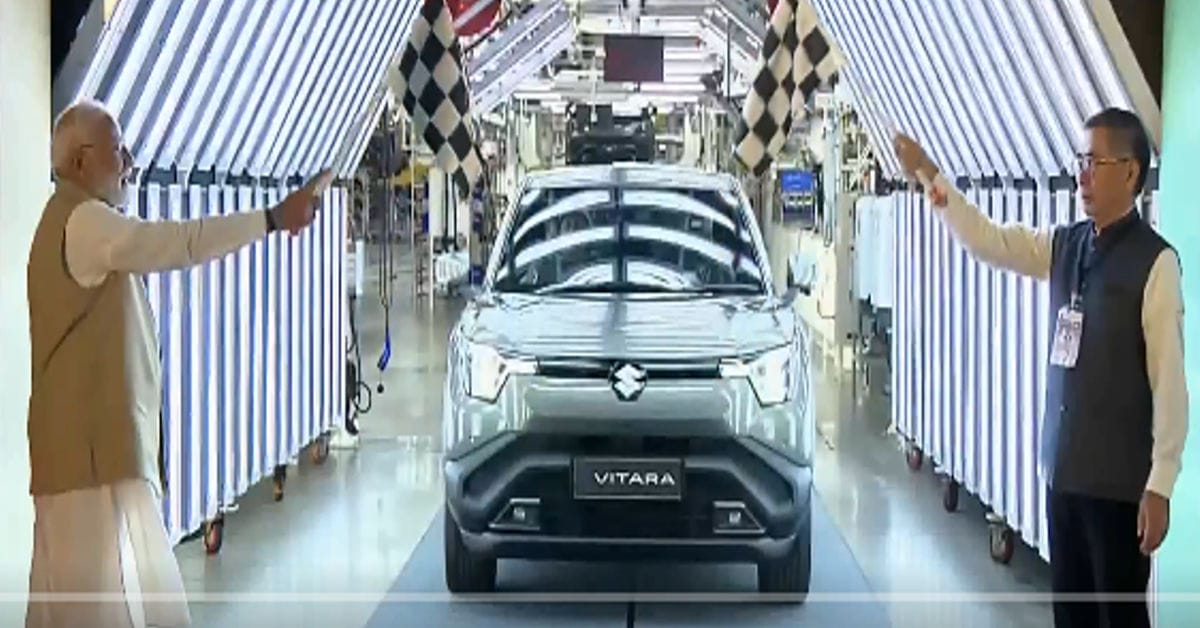
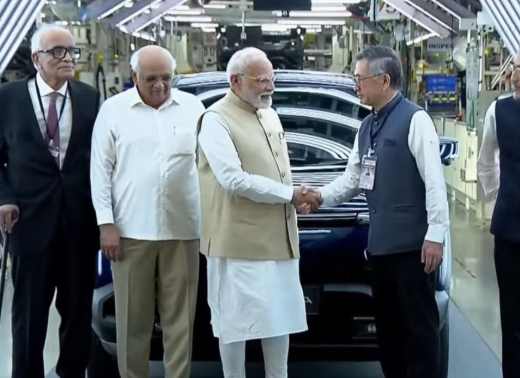
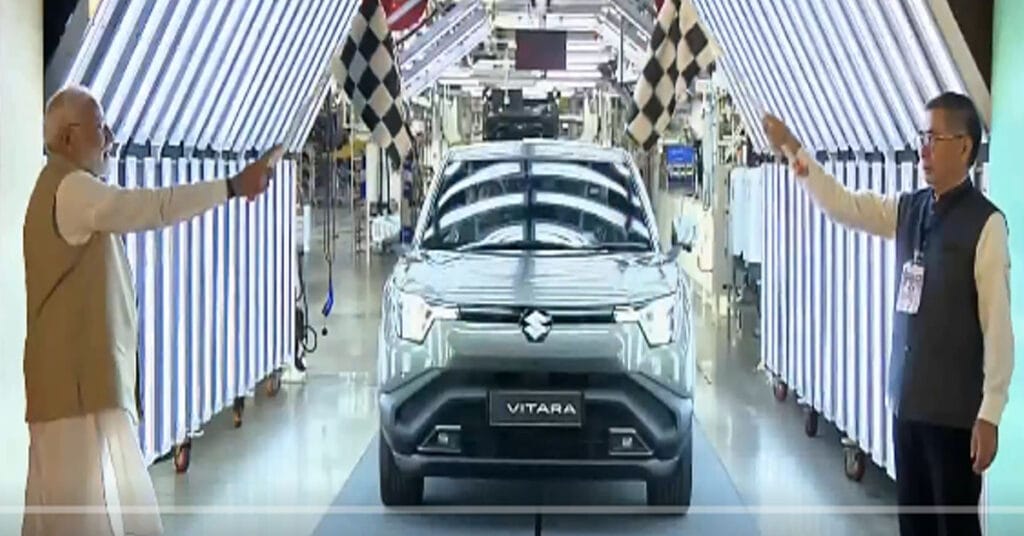
Prime Minister Narendra Modi on Tuesday visited the Suzuki Motor Plant in Ahmedabad, Gujarat, to mark two major milestones for the company and the Indian automobile industry. During his visit, Modi inaugurated the localized production of hybrid battery electrodes, a crucial step toward strengthening India’s clean energy supply chain, and flagged off exports of Maruti Suzuki’s first global battery electric vehicle (EV), the e-Vitara, to more than 100 countries.
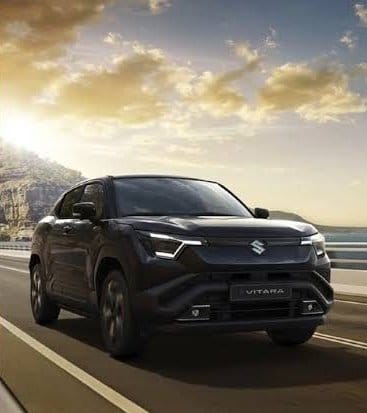
The e-Vitara, first unveiled at the Bharat Mobility Global Expo in January 2025, represents Suzuki’s bold entry into the electric SUV market. With its global rollout beginning from India, the model underscores the country’s growing role as a hub for next-generation automobile manufacturing and exports.
Suzuki’s Growing Global Footprint
Maruti Suzuki has steadily expanded its production and export capacity in recent years. With an annual production capacity of 2.6 million units spread across four Indian plants, the company has positioned itself as a leading contributor to both domestic and international markets.
In FY25 alone, Maruti Suzuki exported over 3.32 lakh vehicles while achieving domestic sales of 19.01 lakh units. These figures highlight the company’s ability to cater to growing demand in India while simultaneously strengthening its international presence.
Models such as the Suzuki Fronx, Jimny, and Baleno have already gained traction overseas, boosting the brand’s reputation globally. Now, with the e-Vitara, Suzuki hopes to capture a share of the rapidly expanding EV market.
The e-Vitara: Suzuki’s First Global EV
The e-Vitara holds special significance for the company as Suzuki’s first battery electric vehicle designed for a worldwide audience. The SUV has been developed with a sharp focus on balancing performance, efficiency, and comfort—qualities that are becoming increasingly important in the EV segment.
The e-Vitara is built on the company’s newly developed HEARTECT-e platform, a ground-up architecture tailored exclusively for electric vehicles. This platform integrates lightweight materials with a robust design to enhance efficiency, safety, and driving dynamics.
Powertrain and Range
The SUV is powered by a 61 kWh lithium-ion battery pack, rigorously tested for durability in extreme conditions ranging from -30°C to 60°C. Suzuki claims the e-Vitara can deliver a range of around 500 km on a single charge, placing it among the higher-range options in its category.
Interestingly, select variants of the e-Vitara will feature a rear-wheel-drive (RWD) layout, making it stand apart in the compact EV SUV segment. The top-tier Empowered trim is also expected to offer all-wheel-drive (AWD) capability, as suggested by earlier leaks.
Features and Technology
Inside, the SUV promises a premium experience with ventilated seats, a flexible boot space, and a host of modern conveniences. The cabin is anchored by a 12.3-inch free-standing infotainment screen, while safety is bolstered by ADAS Level 2 features, providing semi-autonomous driving assistance.
Hyundai Creta EV: The Closest Rival
One of the e-Vitara’s biggest competitors in the Indian and global market will be the Hyundai Creta EV. Hyundai’s entrant into the segment will reportedly be available with 42 kWh and 51.4 kWh battery pack options, offering a claimed range of up to 473 km.
While its range is competitive, the Creta EV falls short in certain areas. Unlike the e-Vitara, Hyundai does not currently plan to provide RWD or AWD configurations, limiting its appeal for buyers seeking more versatile driving capabilities.
Design-wise, the Creta EV sticks closer to a conventional SUV aesthetic, while Suzuki seems to be emphasizing both futuristic styling and enhanced utility.
Another key player in this segment will be the upcoming Tata Harrier EV. Although official specifications of its battery pack are yet to be released, Tata Motors has built a reputation for aggressively pricing its EVs and offering competitive performance features.
Industry watchers expect the Harrier EV to bring strong off-road capabilities and advanced drive modes, potentially giving it an edge over the Hyundai Creta EV. However, until full specifications are revealed, the Suzuki e-Vitara currently looks better equipped in terms of technology and range.
India’s Growing EV Landscape
The launch of the e-Vitara comes at a time when India is rapidly transitioning toward electric mobility. With the government pushing for greater adoption of EVs through policy support and infrastructure development, companies like Suzuki, Hyundai, and Tata are racing to secure their positions in a market projected to grow exponentially over the next decade.
By exporting the e-Vitara to over 100 countries, Suzuki is not only strengthening India’s status as a global EV hub but also setting an example for other automakers to follow. Localized production of hybrid battery electrodes further reinforces this vision, reducing dependency on imports and creating opportunities for domestic innovation.
The launch of the Suzuki e-Vitara marks a turning point for both the company and India’s automotive industry. With a strong range, advanced features, and a platform purpose-built for EVs, the SUV is poised to compete head-to-head with rivals like the Hyundai Creta EV and Tata Harrier EV.
As Prime Minister Modi emphasized during his visit, the move symbolizes India’s emergence as a major player in sustainable mobility. For consumers, the e-Vitara offers an exciting new option in the growing EV segment—one that blends innovation, reliability, and global appeal.
With its debut, Suzuki has clearly signaled that it intends to play a central role in shaping the future of electric mobility, both in India and abroad.