
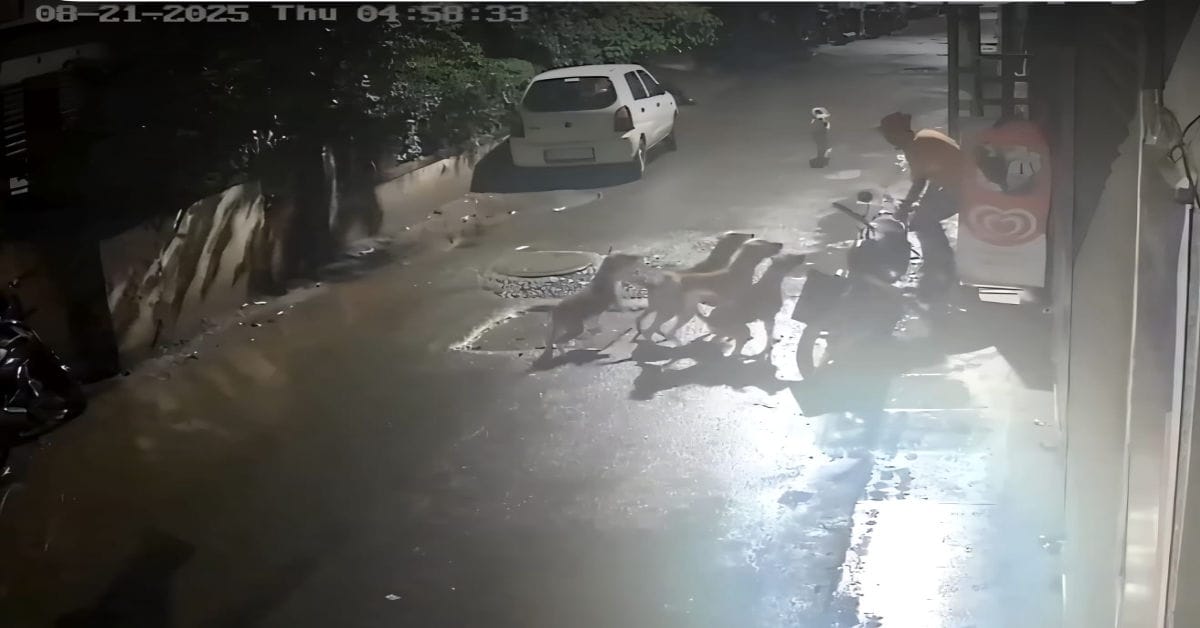
A routine morning walk to work turned into a nightmare for a man in Maharashtra’s Pimpri Chinchwad, when he was attacked by a pack of seven stray dogs in the early hours of Saturday. The terrifying incident, caught on a CCTV camera, has reignited the debate over India’s growing stray dog menace and prompted fresh demands for municipal intervention.

Caught on Camera
The incident occurred around 5 am, when the man was passing through a dimly lit alley on his way to work. A nearly three-minute video from a security camera shows him walking alone when a pack of seven dogs suddenly rushed toward him and began attacking.
Startled and overwhelmed, the man tried to protect himself by quickly jumping behind a parked motorcycle. The dogs circled him aggressively, appearing to lunge and bite. In desperation, the man pushed the bike towards the pack in an attempt to scare them away. Though none of the animals were injured, they refused to back down.
Moments later, locals who heard the commotion rushed out of their homes and managed to chase the dogs away. But the drama did not end there. A few minutes later, the dogs returned to the same spot, seemingly undeterred. This time, the man armed himself with a wooden board, waving it at the animals until they finally fled.
Authorities confirmed that the man sustained injuries during the attack, though his condition remains stable.
The incident has sparked outrage among residents of Pimpri Chinchwad, who have long complained about the stray dog menace in the area. Locals have now called on the Municipal Corporation to take immediate action to ensure public safety.
“This could have been fatal. Children and elderly people walk these streets every day. We need urgent measures to control the population of stray dogs,” said one resident.
A National Debate
The alarming rise in dog attacks and rabies-related deaths has made stray dogs a contentious subject across India. Just last week, the issue reached the Supreme Court, which was hearing petitions related to dog bite incidents in Delhi-NCR and other regions.
Initially, the apex court ordered that all stray dogs in Delhi-NCR and adjoining areas be moved to shelters to protect residents. However, this decision sparked nationwide protests from animal rights activists and dog lovers, who argued that mass relocation was inhumane and impractical.
ALSO READ – Zupee to Keep Ludo, Snakes & Ladders; Ends Money Games
Responding to the backlash, the court modified its order on Friday. A three-judge bench comprising Justices Vikram Nath, Sandeep Mehta, and NV Anjaria clarified that stray dogs could be released back into their original locations after sterilisation and vaccination under the Animal Birth Control (ABC) rules.
What the Court Said
The Supreme Court emphasized a balanced approach that protects both citizens and animals.
- Stray dogs must be sterilised and immunised before being released back into the same locality.
- Rabid or aggressive dogs will not be returned to the streets and must be isolated or sheltered.
- Municipal authorities must establish dedicated feeding zones, where animal lovers can feed dogs under supervision. Feeding in public spaces, however, has been banned, and violations will invite strict action.
- Individuals willing to adopt stray dogs can approach the Municipal Corporation of Delhi (MCD). Once adopted, the dogs cannot be abandoned back on the streets.
The court’s ruling attempts to strike a compromise: safeguarding public safety while upholding animal welfare laws.
India has an estimated 62 million stray dogs, according to government data. While many are harmless, unvaccinated and unsterilised dogs pose a serious health risk, especially in urban centers.
Rabies, a fatal viral disease, remains a major public health issue in India, which accounts for nearly 36 percent of the world’s rabies deaths, according to the World Health Organization. Dog bites are the primary source of infection.
In cities like Pune, Mumbai, and Delhi, residents have repeatedly voiced concerns about rising dog attacks. Children, delivery workers, and the elderly are often the most vulnerable. At the same time, animal rights activists argue that strays are often victims of human neglect and cruelty, and only a systematic sterilisation and vaccination program can bring a sustainable solution.
In Pimpri Chinchwad, where Saturday’s attack took place, the incident has left residents shaken. The CCTV footage has gone viral on social media, fueling debates about whether stricter enforcement of sterilisation programs and designated feeding zones could have prevented such attacks.

“This should be a wake-up call,” said another local resident. “The Supreme Court has laid down clear guidelines, but what use are they if municipal authorities don’t implement them effectively?”
Municipal officials have not issued a formal statement yet, but residents are demanding a survey of stray populations, increased sterilisation drives, and stricter monitoring of feeding practices in public spaces.
The Pimpri Chinchwad stray dog attack underscores the urgent need for a clear, humane, and effective policy on managing India’s vast stray dog population. While the Supreme Court has attempted to balance human safety with animal welfare, real change will depend on local governments implementing sterilisation and vaccination programs effectively.
For the injured man, the incident was a terrifying ordeal narrowly survived. For India, it is another reminder that the stray dog crisis cannot be ignored any longer—not just for the safety of its citizens, but also for the welfare of the animals themselves.